

Have you ever wondered if one small habit could make Scripture feel fresh again?
This list promises practical, heart-level approaches that make reading engaging, doable, and life changing.
Across short, actionable tips you will find a mix of time-tested spiritual practices and modern tools. Each idea helps you build a steady rhythm that strengthens faith and love for God.
We preview a clear story arc: start with prayerful pages in the New Testament, then weave in Old Testament books so you see God’s big story. Expect guidance on choosing a translation, mapping a book, and simple reflection prompts.
Small changes done consistently yield big growth. Every tip can stand alone or combine into a personal plan that fits your schedule today in the United States.
Try one new practice this week and notice how your time with God shifts. The steps here aim to remove overwhelm and invite lasting love for Scripture.
Start with prayer: turn verses into conversations with God
Begin your time with Scripture by turning a single verse into a direct conversation with God. This simple shift moves bible reading from information intake into a relationship that touches the heart.
Pray-read the Word is a modern name for an old practice called Lectio Divina. Pastor Mike Bickle teaches this as a way to pray God’s word back to God.
Pray-read the Word (Lectio Divina) to move truth from head to heart
Try this short pattern: read a few verses slowly, pause, and speak the verse back to God as your own prayer. Then listen and respond. Let the verse lead, not your agenda.
Example prayer from a verse to personalize God’s word
Take Philippians 4:13 (NLT): “For I can do everything through Christ, who gives me strength.” A personal prayer could be:
- “God, thank you that I can do everything through you.”
- “I feel weak and tired—give me strength to ______.”
- “Help me depend on you, not my strength. I’m sorry for relying on ______.”
Tell God when a verse feels hard, ask honest questions, and keep a running list of short prayers you can return to during the day. Start small: five minutes, one verse, one honest prayer.
Practice this week: pray-read one verse and journal how your heart responds. Small, sincere habits build trust and a deeper love for scriptures.
Set a simple schedule you can actually keep
A simple map for a book keeps bible reading from feeling overwhelming. Start with a short plan that fits real life, not a perfect ideal.
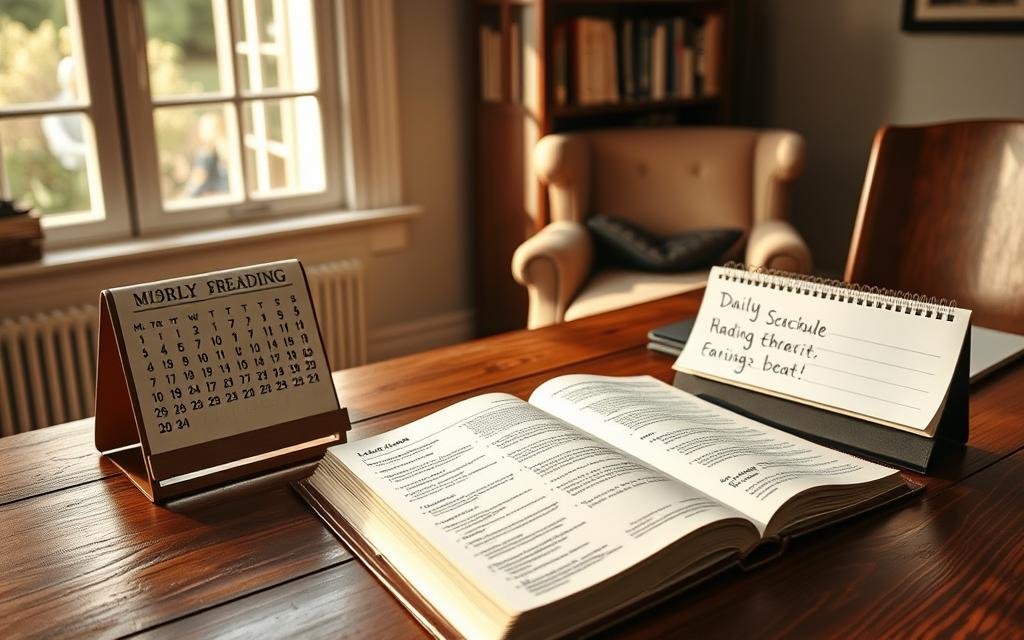
Pick a book, count chapters, and map your days
Map your month: choose one book, count its chapters, pick a finish date, and assign one chapter per day. This removes decision fatigue and makes time with Scripture a clear habit.
Example: Proverbs has 31 chapters. Read one chapter a day and finish in a month. That simple pace gives steady progress and a natural rhythm for daily reading.
Protect a time block—morning coffee, lunch break, or before bed. Start small (10–15 minutes) and build up if you like.
- Build buffer days for busy stretches.
- Use a calendar with checkboxes for each chapter; visual progress motivates.
- Note context (author, audience) in one line to deepen understanding.
One-chapter rule: if you miss a day, don’t double up. Resume the next day and keep the plan sustainable. A schedule should serve you; adjust it and celebrate small wins as you refine the plan.
Choose a translation that fits your season and purpose
Picking the right English rendering can change how Scripture connects with your heart this season. Translations sit on a spectrum from formal equivalence (word-for-word) to free paraphrase. Each choice affects how words, rhythm, and nuance reach you.

- Literal (KJV, NKJV, NASB, ESV) keeps close to original words. Great for careful study and deeper bible study.
- Functional (NIV, NLT, CSB) balances accuracy and clarity. Use this version for steady reading and devotion.
- Paraphrase (The Message, The Passion) rephrases ideas for readability. It helps hear familiar passages with fresh life or when introducing someone to faith.
Try a simple practice: read a Psalm in ESV, then NLT, then The Message. Note which phrases hit you and which clarify the passage’s intent. A study bible or app can help by showing footnotes and alternate words for tricky verses.
Tip: pick one primary translation for continuity and add a secondary for comparison. If your routine stalls, switching a translation often helps you read bible with new curiosity and renewed focus.
Write while you read: journaling, questions, and highlighting
Writing as you read turns short moments with God into a visible story you can revisit. Use a study Bible or a simple notebook and capture what stands out. Jotting notes helps your heart process verses and builds a record you can scan later.

Use a study Bible or a notebook to track insights and questions
Bring a pen. Mark key verses, write questions in margins, or use cards and post-its if you prefer not to write in a paperback Bible. A dedicated page creates a searchable trail of study notes.
- Write a short template: date, passage, what I learned about God, how it applies, and one question.
- Color-code highlights for character, commands, promises, and response so themes pop on repeat readings.
- Jot one sentence each session about what moved your heart; depth grows without long entries.
Minimize phone distractions during reading. A paperback copy helps you linger on verses away from app alerts.
Practice: try a one-week experiment with a notebook. Each day write one line and one question. At week’s end, skim your notes, circle one takeaway, and pray it back to God.
Use your phone for good: Bible apps, audio, and reading plans
Make your phone a tool that invites short, steady encounters with God. A few trusted apps can protect your time and help people build a habit that sticks.

Top app options include YouVersion, The Bible Project, She Reads Truth, He Reads Truth, and Sprinkle of Jesus. Install one and enable gentle reminders that guard a short daily slot.
Build a simple on-the-go rhythm: listen to one Psalm on your commute, read a Gospel paragraph at lunch, and review one verse before bed. Audio Bibles are perfect for busy days and let you read bible by listening while you move.
- Try the “Word before World” 30-day challenge for a guided reset and group accountability.
- Explore the Community Bible Experience for audio, e-books, and versions that remove chapter markers so the story flows.
- Share a plan link with a friend and sync start dates for mutual help and motivation.
Quick boundary tip: turn on Focus Mode during your reading window and save favorite verses as widgets or lock-screen images. Choose one app and commit to a seven-day trial to see a real change.
Make it social: community Bible experiences and book clubs
Reading together brings Scripture alive. A short, shared schedule turns bible reading into a steady habit that feels joyful rather than lonely.

How a book club builds accountability and joy
Invite a few friends, pick one book, and set a weekly pace. Meeting regularly lets the group track progress through the story and celebrate small wins.
- Start simple: agree on a chapter goal and a fixed time to meet.
- Rotate roles: host, facilitator, question-asker, and note-taker share responsibility.
- Try online options: church groups or Christian Facebook groups work well when meeting in person is hard.
Consider the Community Bible Experience for an immersive eight-week New Testament read that reads more like a continuous narrative. Begin each meeting with a brief prayer, a short summary, and two open questions. Text one friend today and propose a trial month with a short Gospel—community helps you return, understand more, and grow in love.
Focus on the New Testament first, then weave in the Old
Start with the Gospels and Epistles so the story of Christ and the early church shapes your reading. This gives immediate clarity about Jesus, grace, and the mission that frames the rest of scripture.
Read the Gospels and Epistles with audience and authors in mind
Ask who wrote this and who received it. The Gospels present Jesus’ life for you; Epistles answer real community questions. Noting author and audience turns words into pastoral help for your heart.
Link themes across Testaments to see one unfolding story
Track themes—promise and fulfillment, law and grace, temple and presence—so you see a single story across years. Use a one-sentence summary for each passage, one clarifying question, and one application for your life today.
- Old Testament habit: read one chapter a day and note what it shows about God, people, and how it points to Christ.
- Watch development: mark how writers change across years—Paul in Acts vs. later letters, John as elder in 1–3 John.
- Cross-check: glance at another translation or version when a passage feels dense; keep the main point central.
Keep a running list of recurring words (faith, covenant, kingdom) and where they appear. Try a four-week plan: two weeks in a Gospel, one week in selected Epistles, and one sampling Old Testament chapters. Record one insight each day and let the god word shape your heart as you study and read word by word.
Try a reading challenge to rekindle your zeal
Join a short, focused reading challenge when your regular rhythm feels flat. A defined plan gives clear steps for each day and frees up decision energy so you actually make time for Scripture.
Why a challenge helps: it supplies structure and fresh energy when motivation dips. Pick a scope that fits your life—seven days in a Psalm set, thirty days in a Gospel, or an eight-week New Testament read.
- Example: the “Word before World” 30-day plan focuses on why we read, where we read, and building a daily habit.
- Invite one or two people for accountability and quick check-ins when things feel hard.
- Plan a simple schedule: list each chapter for each day with one takeaway and one short prayer.
Practical tip: use a calendar or tracker to see streaks, pair the challenge with the same cue (same time and place), and celebrate small wins. Pick a start date this week and text a friend to join you.
Create space: trade screen time for Scripture time
Trade a little screen time each day for a quiet block with Scripture and notice how your rhythms change. Social feeds and TV can eat hours through autoplay and habit loops. That leaves many people saying they lack time for what matters most.
Make a simple swap: set aside a portion of phone or streaming time each day and use it first for a short reading. Try one chapter before your shows or 15–20 minutes at your morning coffee.
Set clear boundaries: no social feeds until after your reading, turn off auto-play, or create a tech-free corner with a chair, a Bible, and a pen. Small changes reset how your day and life feel.
- Use your phone as an ally: alarms, Focus Mode, and scheduled do-not-disturb windows.
- Swap late-night scrolling for a short psalm to improve rest and reflection.
- Invite others at home to cheer you on or join for shared accountability.
This shift isn’t about guilt but love. Choose one boundary today and make room for Scripture tomorrow. Even trimming 15 minutes each day can reshape your reading habit and renew a calm, centered way of life.
Support your journey with trusted books and resources
A single reliable book or plan often unlocks clearer rhythms and renewed joy in daily study. Start with one practical book that deepens your study habits and journaling practice.
Helpful titles: try The Divine Mentor by Wayne Cordeiro for daily time, Women of the Word by Jen Wilkin for a clear study method, and Sensible Shoes by Sharon Garlough Brown if you connect more through story.
Choose a study bible with concise notes and maps so context is available without overload. If you want steady progress, try a one-year reading Bible or a dated plan that moves you through Scripture over the years.
- Use one solid translation and one comparison version when a passage feels dense.
- Supplement with apps like YouVersion or She Reads Truth for plans and audio help.
- Rotate resources occasionally to keep your practice fresh while Scripture remains central.
Try one resource this month: test how it supports your pace, clarity, and joy. Then share favorites with a friend or group and build a small, trusted library of books that encourage regular reading and study.
Ways to Enjoy Reading the Bible: reflect, apply, and share daily
Let simple reflection turn a passage into living guidance. End each session with two or three heart-level questions that move the word from idea into action in life today.
Ask heart-level questions and live one verse at a time
Use a three-question frame: What did I learn about God? What did I learn about people? What will I do differently because of this verse?
Choose one verse to carry through the day—memorize a phrase, pray it at meals, or share it with a friend for accountability. Keep a short application journal with the verse, the one thing God highlights, and the next step.
- End reading with two quick questions that push the word into daily choices.
- Record one small obedience. Small, faithful things build deep roots of faith over time.
- Share a takeaway with your group or family; speaking it aloud clarifies conviction and spreads love for Scripture.
Try the Ruth approach: note God’s character, your response, and one practical step that shows trust today. Revisit the chosen verse at night and write how God met you—this closes the loop between morning intent and daily practice.
Conclusion
, Short, focused time with Scripture invites God’s voice into ordinary hours. Start in the New Testament for clarity, then weave in the Old so one story of redemption becomes clear. A simple schedule or a short plan protects quiet minutes and makes steady progress in reading.
Use clear translations and compare a translation now and then. This refreshes insight without adding confusion. Let the god word shape your heart and guide small choices that grow faith and love.
Pick one practical step today: set a time, try pray-read one verse, or text a friend. Write one takeaway and turn it into a short prayer.
There is no perfect method—only faithful steps that change life. Open your Bible, ask God to speak, and start now.
