
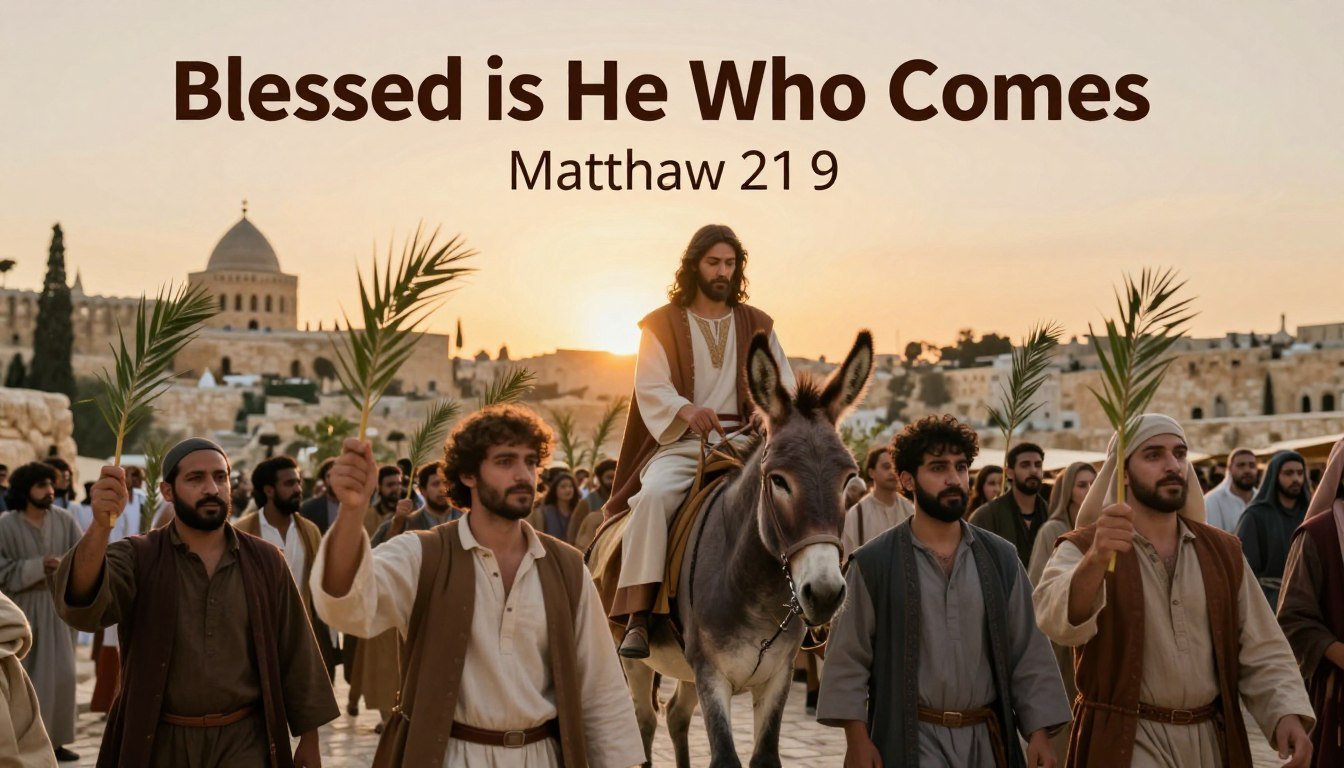
Think about your faith journey. You might remember special moments that made you understand God’s plan better. One key moment is in Matthew 21:9. Here, the crowd welcomes Jesus into Jerusalem with a powerful shout.
The phrase “Blessed is he who comes in the name of the Lord” comes from Psalm 118:26. It shows Jesus’ special mission. This verse is important for knowing who Jesus is and why He came. It’s not just about the past but also about what it means for us today.
Looking into this verse will help you understand its background and meaning. You’ll learn how it connects to our faith today. It will help you see the Bible’s teachings in a new light.
The Complete Passage in Context
To understand Matthew 21:9, we must look at what happened before Jesus entered Jerusalem. This is shown in Matthew 21:1-11. It helps us see why the crowd said, “Blessed is he who comes in the name of the Lord.”
Overview of Matthew 21:1-11
Matthew 21:1-11 tells us about Jesus’s big entrance into Jerusalem. Before he got there, he sent two disciples to get a donkey and a colt. This was to fulfill a prophecy from Zechariah.
The people put their cloaks and branches on the road. They cheered Jesus, calling him the “Son of David.” This event was important for Jesus’s role and for fulfilling old prophecies.
Jesus’s arrival showed his power and mission. People cheered and said he was blessed. The story is full of signs that Jesus was the Messiah.
Key Phrases and Their Immediate Context
In Matthew 21:1-11, some phrases are very important. “Hosanna to the Son of David” and “Blessed is he who comes in the name of the Lord” stand out. These phrases connect to Jewish scripture and hopes for the Messiah.
The crowd’s words were a natural reaction to Jesus’s arrival. Yet, they also matched what was predicted in scripture.
The phrase “Blessed is he who comes in the name of the Lord” comes from Psalm 118:26. This psalm was important in Jewish worship and hopes for the Messiah.
Narrative Flow and Dramatic Significance
The story in Matthew 21:1-11 builds up to a big moment in verse 9. It combines prophecy, messianic hopes, and Jesus’s authority. This makes a strong story that shows Jesus is the Messiah.
The crowd’s cheers in Jerusalem were more than just excitement. They saw Jesus’s divine mission, based on their knowledge of Jewish scripture.
The Historical Context of Jesus’s Triumphal Entry
Jesus’s triumphal entry into Jerusalem was set against a backdrop of political and religious tensions. To grasp Matthew 21:9’s significance, we must explore the setting of Jesus’s arrival.
Political Climate in First-Century Jerusalem
Jerusalem in the first century was a city of complex politics. The Roman Empire controlled Palestine firmly. The Jewish people were eager for a messiah.
Roman soldiers and the Sadducees, who worked with the Romans, heightened the tension.
The Jewish people yearned for a messianic savior, even more so during Passover. This festival celebrated their freedom from slavery.
Expectations of the Messiah During Passover
Passover was a time of high hopes for the Messiah. The Jewish people were celebrating their freedom. They looked for a savior from Roman rule.
The crowd welcomed Jesus with great excitement, seeing him as a possible savior.
The shouts of “Hosanna” and “Blessed is He” were more than greetings. They were declarations of hope and expectation.
Significance of Palm Sunday in Jewish Tradition
Palm Sunday is key in Jewish tradition. The use of palm branches symbolized peace and victory. This tradition comes from the Feast of Tabernacles and other celebrations.
Reflecting on Jesus’s entry into Jerusalem, we see the rich Jewish traditions and the complex political and religious forces. Understanding Matthew 21:9 in this context reveals the deep meaning behind Jesus’s actions and the crowd’s response.
Textual Analysis of Matthew 21:9
The phrase “Blessed is he who comes in the name of the Lord” in Matthew 21:9 is more than a simple greeting. It’s filled with history and deep meaning. We need to look at the original Greek text, see how different Bibles translate it, and understand the words’ meanings.
Original Greek Text Examination
The original Greek text of Matthew 21:9 gives us important insights. The phrase “ὁ ἐρχόμενος ἐν ὀνόματι κυρίου” (ho erchomenos en onomati kyriou) is key. The word “ὁ ἐρχόμενος” (ho erchomenos) means “the one who comes” or “he who comes.” It shows Jesus is the Messiah coming to the world.
Translation Variations Across Bible Versions
Different Bibles translate Matthew 21:9 in different ways. For example, the King James Version (KJV) says “Blessed is he that cometh in the name of the Lord.” The New International Version (NIV) says “Blessed is he who comes in the name of the Lord.” These small changes can change how we see the verse.
Linguistic Nuances of the Phrase
The phrase “in the name of the Lord” is very important. It means Jesus comes with God’s power and authority. The Greek word “ὀνόματι” (onomati) means “name,” but here it means God’s character and power. So, Jesus’s arrival in Jerusalem is not just a physical event but a sign of His divine mission.
By looking at the original Greek text and seeing how different Bibles translate it, we learn more about Matthew 21:9. This verse is not just a story from the past. It’s a deep theological message that speaks to believers today.
The Old Testament Roots: Psalm 118 Connection
Exploring Matthew 21:9 reveals a deep link to Psalm 118. This shows Jesus’s role as the Messiah. It’s a clear connection between the Old and New Testaments, showing God’s plan of salvation.
Understanding Psalm 118:26 in Its Original Context
Psalm 118:26 says, “Blessed is he who comes in the name of the Lord.” It was part of Jewish worship and tradition. It was used during Passover to welcome pilgrims to Jerusalem.
This verse welcomed those coming in God’s name. It showed divine approval and blessing.
To learn more about Bible prophecies, check out examples of prophecies in the Bible. It helps understand messianic prophecies better.
How Jesus Fulfilled This Messianic Prophecy
Jesus entered Jerusalem, as Matthew 21:1-11 tells us. The crowd cheered, saying “Blessed is He who comes in the name of the Lord” (Matthew 21:9). This showed Jesus was the Messiah.
Jesus’s actions and the crowd’s cheers were not random. They were part of a bigger story. This story connected Jesus to Jewish scriptures and expectations.
The Significance of Quoting Psalms During Jesus’s Entry
Quoting Psalm 118:26 during Jesus’s entry was important. It showed Jesus’s divine mission and His connection to Old Testament prophecies. It also showed the crowd saw Jesus as the Messiah, even if they didn’t fully understand.
This act linked Jesus’s life and ministry to Jewish scripture. It showed a strong bond between the Old and New Testaments.
Looking at Matthew 21:9 and Psalm 118:26 helps us understand Jesus’s entry into Jerusalem. It shows Jesus’s messianic identity and the link between the Old and New Testaments. This deepens our appreciation of the biblical story.
The Meaning of Matthew 21:9 “Blessed is He Who Comes in the Name of the Lord”
In Matthew 21:9, people say ‘Blessed is He Who Comes in the Name of the Lord’. This phrase is very important. It shows Jesus is the Messiah and talks about God’s power and saving grace.
Unpacking the Phrase Word by Word
To understand “Blessed is He Who Comes in the Name of the Lord,” we need to look at each word. ‘Blessed’ means being favored by God. ‘He who comes’ is about the Messiah, the one expected to arrive.
The part ‘in the name of the Lord’ is key. It shows Jesus comes with God’s authority. ‘The Name of the Lord’ is a special way to talk about God, showing His power.
The Theological Implications of “Coming in the Name of the Lord”
Coming in the name of the Lord means Jesus acts with God’s power. His entry into Jerusalem shows He is on a divine mission. It shows He is God’s envoy, sent to fulfill old prophecies.
The theological implications are deep: it shows Jesus is connected to God, making Him the Messiah. This is not just a hello; it’s a deep faith statement, showing Jesus’s divine authority and mission.
How First-Century Jews Would Have Understood This Declaration
For first-century Jews, “Blessed is He Who Comes in the Name of the Lord” was very meaningful. It comes from Psalm 118:26. They saw it as a greeting for the Messiah, the one with God’s power.
The Significance of the Name of the Lord
The ‘Name of the Lord’ is about God’s character and power. When Jesus is hailed as coming in the Name of the Lord, it means He comes with God’s power. He shows God’s character and does God’s will.
This idea was new and exciting for first-century Jews. It linked Jesus to God, making Him the Messiah and Lord.
The Crowd’s Response: Recognition of Divine Authority
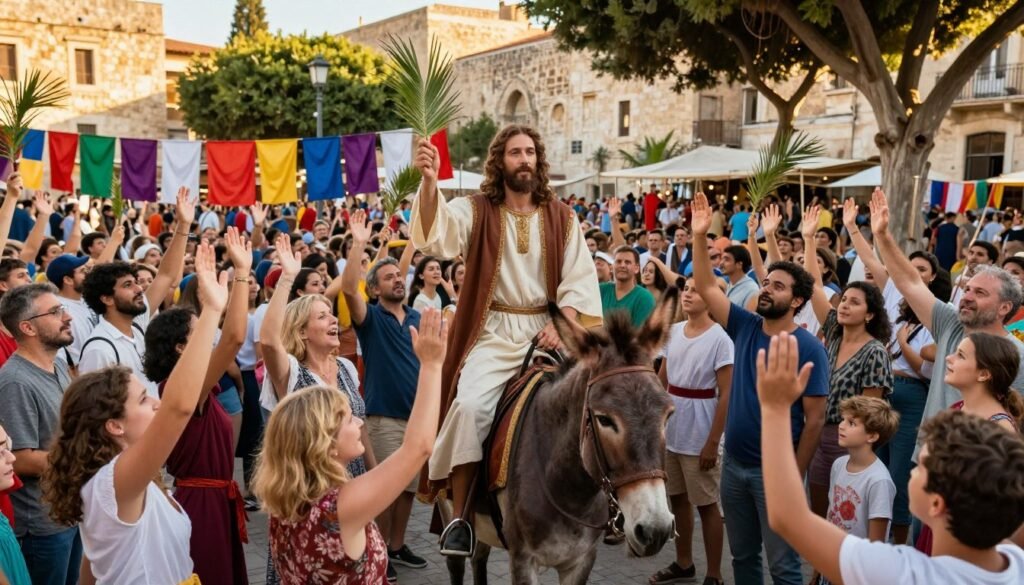
When Jesus entered Jerusalem, the crowd cheered. They saw His divine authority. This moment was key in the Bible, showing Jesus and the people’s complex relationship.
Who Was in the Crowd and Why They Gathered
The crowd was made up of many people. There were pilgrims for Passover and locals curious about Jesus. They came because of His miracles and teachings.
They were not just there by chance. They came because of Jesus’s fame and the hope for the Messiah. Knowing who was there helps us understand why they cheered for Jesus.
The Significance of Their Proclamation
The crowd called Jesus “Blessed is he who comes in the name of the Lord.” This was a big deal. They saw Jesus as the Messiah they had been waiting for.
This was more than a simple hello. It was a deep statement of faith. By saying Jesus was blessed, they showed they believed in Him.
Contrast Between Their Welcome and Later Rejection
The crowd first welcomed Jesus as the Messiah. But later, they turned against Him. This change was because of the leaders.
This change shows how people can change their minds. It shows the ups and downs of faith. It also shows the challenges Jesus faced and the emotions of the people.
Parallel Gospel Accounts of This Declaration
The saying ‘Blessed is He Who Comes in the Name of the Lord’ is found in all four Gospels. Each one has its own special touches. As you read Matthew, Mark, Luke, and John, you’ll see both the same and different stories.
Comparing Matthew’s Account with Mark, Luke, and John
Matthew, Mark, and Luke are very similar in their stories. They all tell how the crowd cheered when Jesus came to Jerusalem. For example, Matthew 21:9, Mark 11:9, and Luke 19:38 all say ‘Blessed is He Who Comes in the Name of the Lord.’
John’s Gospel is different in John 12:13. The crowd says ‘Hosanna’ and calls Jesus the ‘King of Israel.’
Unique Elements in Matthew’s Version
Matthew’s story has special details that make it stand out. For instance, Matthew 21:5 quotes Zechariah 9:9. This shows Jesus is the Messiah, as predicted in the Old Testament.
Synthesizing the Complete Picture Across Gospels
By looking at all four Gospels together, we understand more. The main message is the same, but each writer adds their own twist. This makes the story of Jesus’s entry into Jerusalem richer and more meaningful.
Reflecting on these stories, we can appreciate the Bible’s depth. It helps us grow in our faith.
Jesus’s Later References and Eschatological Implications
As we look into Jesus’s later teachings, we find a deep link. This link is between the crowd’s shout and Jesus’s second coming. This connection is not easy to see at first but becomes clear when we look at Matthew 21:9.

Matthew 23:39 and Jesus’s Prophecy About Jerusalem
In Matthew 23:39, Jesus says, “For I tell you, you will not see me again until you say, ‘Blessed is he who comes in the name of the Lord!'” This is important because it links the crowd’s shout to a future event. Jesus is saying that the people of Jerusalem will not see Him again until they say these words. This shows a future acceptance of Him.
This prophecy has eschatological implications. It points to a future when Jesus will return. Then, the people will recognize Him as the Messiah. It’s a message of hope, showing a future day when the Jewish people will welcome Jesus back.
Connection to Jesus’s Second Coming
The link between Jesus’s statement in Matthew 23:39 and His second coming is key. It shows the crowd’s shout in Matthew 21:9 was more than just joy. It was a hint of a future event. Jesus’s return is expected to be a time of universal recognition and welcome.
Jesus’s teachings often had layers of meaning. Some were fulfilled soon, others later. The crowd’s shout is a bridge between Jesus’s first and second comings.
The “Blessed is He Who Comes” as a Future Proclamation
Seeing “Blessed is He who comes in the name of the Lord” as a future shout gives us new insights. It shows Jesus’s second coming will be a time of universal recognition and worship. For believers, this understanding brings comfort and hope, knowing Jesus’s return will be a time of ultimate vindication and glory.
In conclusion, Jesus’s later teachings about the crowd’s shout in Matthew 21:9 add depth to our understanding of His second coming. This connection highlights the importance of the crowd’s words and offers a hopeful perspective for Christians.
Applications for Contemporary Christian Faith
Matthew 21:9 is a powerful message for deepening your faith. It tells us to see Jesus’s authority in our lives. This quote, “Blessed is he who comes in the name of the Lord,” guides us today.
Recognizing Jesus’s Authority in Personal Life
Seeing Jesus’s authority means letting Him lead your life. It’s about giving up your own will and seeking His guidance. This makes your faith real and alive every day.
Practical ways to recognize Jesus’s authority include:
- Starting your day with prayer, seeking God’s guidance
- Reflecting on biblical teachings and applying them to your life
- Engaging in acts of service and kindness as a reflection of Christ’s love
Worship Implications: Declaring Jesus as “Blessed”
Calling Jesus “Blessed” is a deep act of worship. It shows we see Him as our Savior. In our worship, saying this reminds us of Jesus’s importance in our lives.
Incorporating this declaration into your worship can be done through:
- Using it in personal or corporate prayer
- Reflecting on its meaning during Bible study or devotional times
- Including it in your daily affirmations or meditations
Living in Anticipation of Christ’s Return
Waiting for Christ’s return means living with the hope He could come soon. This mindset makes us live in a way that pleases Him. It’s about seeing the big picture and knowing our actions matter.
To live in anticipation of Christ’s return, consider:
- Regularly examining your heart and actions to align with God’s will
- Sharing the gospel with others, fulfilling the Great Commission
- Being prepared to give an account of your faith to others
Conclusion: The Enduring Significance of “Blessed is He Who Comes”
You’ve learned about “Blessed is he who comes in the name of the Lord” in Matthew 21:9. This saying comes from Jewish scripture and Jesus’s entry into Jerusalem. It’s important for Christians today.
This phrase shows Jesus’s power and mission. It makes you see Jesus’s role in your life. It also makes you look forward to His return.
In short, “Blessed is he who comes” is very important. It helps grow your faith, guides your worship, and keeps hope alive for Christ’s return. May it always make your faith stronger.
