

Can one family shape a nation’s map and leave a mystery that lasts millennia? This guide answers that question with clear facts and readable history.
Jacob’s household became twelve tribal ancestors named Reuben, Simeon, Levi, Judah, Dan, Naphtali, Gad, Asher, Issachar, Zebulun, Joseph, and Benjamin. Joseph’s sons, Ephraim and Manasseh, often appear as separate groups, so lists vary across texts.
Expect a concise survey: origins, how land was divided under Joshua, Levites’ unique city allotments, and how monarchy split into north and south. We track decisive exiles—Assyria’s displacement and Babylon’s deportation—and show how those events shaped later scripture and tradition.
This section previews symbols, scriptural sources, and modern identity claims. It sets up a historically grounded guide that blends primary passages with archaeology and scholarship to make complex material accessible for readers in the United States and beyond.
What are the Twelve Tribes? A quick overview of ancient Israel’s family of tribes
One patriarch’s sons became named groups that later anchored territory, ritual, and memory.
Jacob’s household produced twelve named tribal groups through four mothers: Leah, Rachel, Bilhah, and Zilpah. Each son’s name grew into a clan identity tied to land, labor, and leadership roles in ancient israel.
From Jacob to Israel: sons, mothers, and the rise of a nation
Leah and Rachel bore most sons, while maidservants Bilhah and Zilpah supplied two each. Birth order and parental favor shaped later blessings and rivalries.
Why “twelve” sometimes looks like “thirteen” in biblical lists
Joseph received a double portion when his sons, Ephraim and Manasseh, were raised to tribal status. That choice can make lists show Joseph as one entry or split him into two.
- Land vs. priesthood: Levites often do not appear among landowners because they received cities and religious duties instead of contiguous territory.
- Political split: After monarchy, Judah and Benjamin formed a southern realm while many other tribes clustered in a northern kingdom.
- Textual variance: Genesis, Deuteronomy, and Revelation present different enumerations, so counts shift with context and purpose.
Quick note: Beyond core clans, biblical texts mention allied groups like the Calebites and Kenites, showing a wider social network during that period.
Origins and genealogy: Jacob’s sons, Joseph’s double portion, and tribal names
Family relationships in Jacob’s house set the pattern for later clan boundaries and roles.
Leah bore Reuben, Simeon, Levi, Judah, Issachar, and Zebulun. Rachel gave Jacob Joseph and Benjamin. Bilhah produced Dan and Naphtali, and Zilpah gave Gad and Asher.
Reuben lost his birthright, and Joseph received a double portion. That shift created two lineages when his sons—Ephraim and Manasseh—became distinct groups.
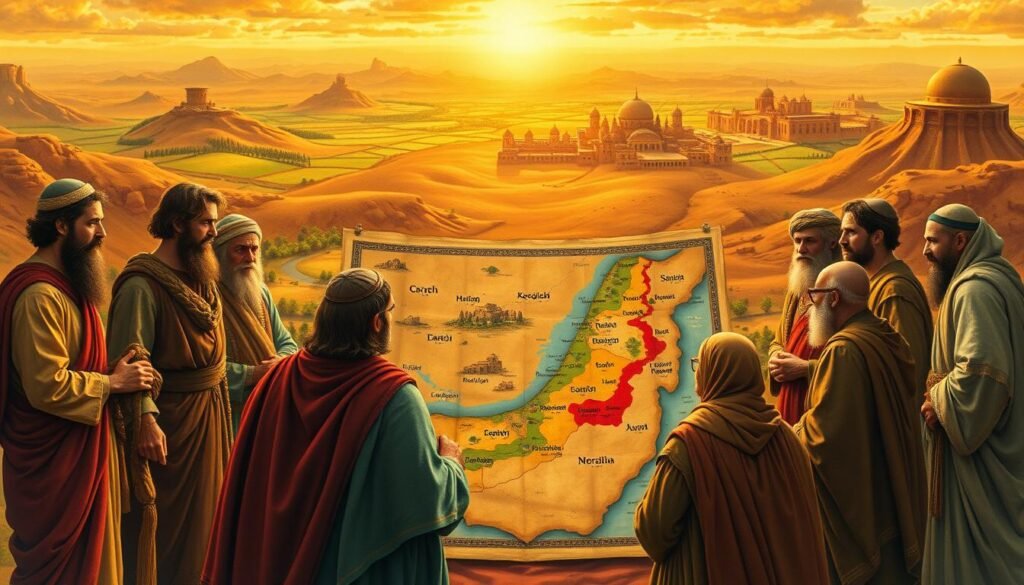
How blessings shaped leadership and roles
Jacob’s blessings (Genesis 49) and Moses’ words (Deuteronomy 33) cast future roles. Judah is tied to leadership and kingship.
“A scepter will not depart from Judah,”
This prophetic tone links family status to later political reality. Many names became both clan and place names, blurring person and region.
- Household map: mothers and their sons form the basic social map.
- Balance: Ephraim and Manasseh keep the tribe count steady when Levi is non-territorial.
- Sibling dynamics: rivalry and alliance among brothers forecast later cooperation and conflict.
Land allotment in Canaan: how the tribes received their territories
Joshua lays out a practical plan: lots decided which clan held which tracts, while named towns and border markers anchored each claim.
Joshua 13–19: lists show Reuben, Simeon, Judah, Issachar, Zebulun, Dan, Naphtali, Gad, Asher, Benjamin, and Joseph’s two portions—Ephraim and Manasseh—receiving mapped parcels and key cities.

Lots, borders, and cities across the Promised Land
Territories were assigned by lot with detailed boundary descriptions. Major towns signaled economic and strategic value.
Later rabbinic reading (Bava Batra 106b) adds a legal nuance: a lot clarified destiny, but ownership often became real only after settlement and cultivation.
Levi’s unique role: priestly cities and the Cities of Refuge
The tribe levi received no contiguous estate. Instead, 48 priestly cities were scattered among partners, including six Cities of Refuge for fair trial and asylum.
- East-bank settlements: Reuben, Gad, and half-Manasseh settled east of Jordan but aided west-bank conquest.
- Enclaves: Simeon’s lands sat within Judah’s borders, showing nested claims and mixed control.
- Geography and economy: coastal districts favored trade while valleys and hills supported agriculture and oil production.
These allotments shaped later political lines and remained a memory framework even as actual control shifted in subsequent centuries.
From united monarchy to divided kingdoms: Israel in the north, Judah in the south
After Solomon, Israel’s single kingdom fractured, setting two rival states on separate courses.
One part became a southern kingdom centered on Jerusalem. Judah and Benjamin formed its core, with the Temple and the city as political and religious anchors.
In contrast, the northern kingdom gathered most other tribes into a separate realm. Capitals, cult sites, and policies differed and rivalry grew.

Judah, Benjamin, and Levite alignment
Many Levites moved south to serve at Jerusalem’s Temple. 2 Chr 11:13 notes priests and Levites left northern cults for centralized worship.
Ephraim as a label for the north
Prophets often name Ephraim as shorthand for the northern polity. That tribe’s prominence and location made its name stand in for a wider political identity.
- Religious split: Jeroboam set cult centers at Bethel and Dan, creating rival shrines and golden calves.
- Political arc: A string of kings and conflicts left both states vulnerable to larger empires.
- End point: Assyria conquered the northern kingdom; later Babylon took Judah, reshaping national memory.
“A period of parallel histories, diplomacy, war, and prophetic critique marked these years.”
That split remains a key part of later prophetic visions, exile narratives, and how tribes israel are remembered in history.
Exile, dispersion, and the legacy of the Lost Tribes of Israel
Conquest and forced migration reshaped northern populations and planted seeds for exile memories.
Assyrian policy moved large groups and resettled them across the empire. Tiglath-Pileser III deported Reubenites, Gadites, and half-Manasseh to places named Halah and the Gozan River (1 Chr 5:26). These relocations fragmented clan networks and feed later stories about lost tribes.
Archaeology supports parts of this account. The Mesha Stele, for example, records “men of Gad” in ninth-century BCE conflicts. Such inscriptions confirm tribal presence before disappearance from some records.
“Deportation and resettlement turned local communities into diasporas remembered as missing lineages.”
- Assyrian tactic: population transfers that mixed peoples across nations.
- Babylonian exile: Judah and Benjamin were deported but some returned after 70 years and rebuilt the Temple (Ezra).
- Legacy: northern dispersal often remained permanent, creating the lost tribes motif in later history.
Over time, families and men dispersed, assimilated, or kept identity. That process shaped prophetic hopes for restoration and set the stage for later claims by communities who trace descent to those exiled groups.
Symbols, emblems, and identities associated with the Twelve Tribes
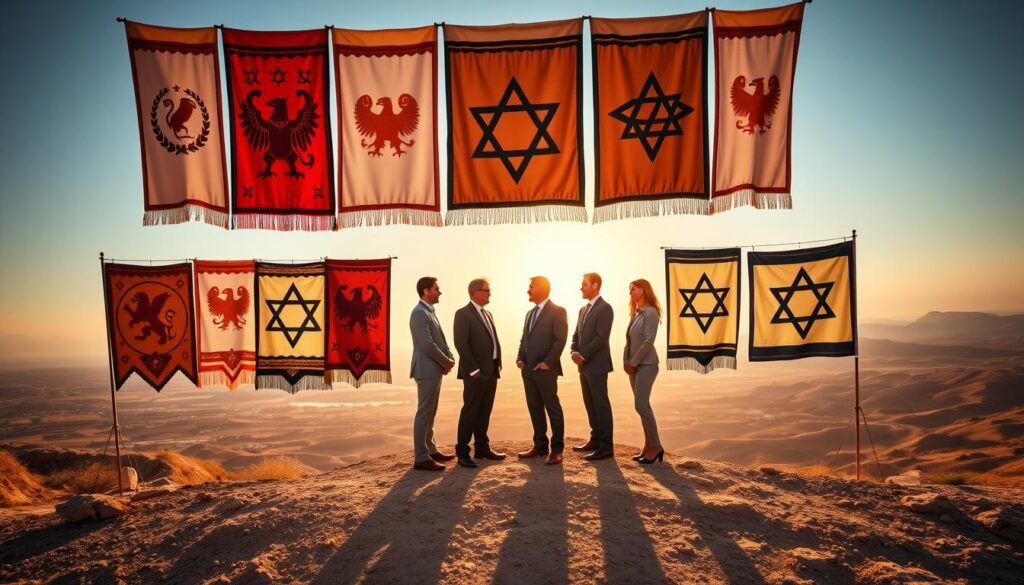
Genesis 49 and Deuteronomy 33 supply most poetic phrases that later inspired emblematic art. Mosaics in ancient synagogues pair Hebrew names with animals, plants, and objects to fix those links in stone.
Lion, ship, olive tree, and other traditional emblems
- Judah — lion, a symbol of leadership and royal aspiration.
- Zebulun — ship, pointing to coastal trade and maritime ties.
- Asher — olive tree or oil, reflecting fertile groves and local produce.
- Levi — Urim and Thummim or priestly breastplate, signaling cultic mediation.
Other associations include Dan as a snake, Naphtali as a deer, Issachar linked to sun, moon, and stars or sometimes a donkey, and Joseph shown as a bull. Reuben, Simeon, Gad, and Benjamin receive water, gates, military tent, and twin hills in various traditions.
Art and identity: Heraldic motifs helped men recognize membership across centuries. Some European coats of arms later attributed names to these groups, but such designs are retrospective, not ancient artifacts.
“Symbols condensed poetic blessings into visual badges used in worship and community life.”
The 12 Tribes of Israel in the New Testament and later traditions
New Testament writers reuse tribal language to make claims about judgment, restoration, and belonging.
Gospel passages such as Matthew 19:28 and Luke 22:30 place disciples in a role that echoes ancestral judges, promising authority over tribal seats in an eschatological renewal.
James opens with a direct address to “the twelve tribes scattered abroad,” using that phrase to bind Jewish-Christian audiences across diaspora life.
How Revelation reshapes lists and meaning
The book of Revelation rewrites earlier rolls: its list omits Dan, includes Levi, and names Joseph alongside Manasseh. These shifts affect interpretation.
“A symbolic census that pairs names with the New Jerusalem’s gates highlights covenant continuity.”
This version ties tribal names to city gates (Revelation 21:12–13), echoing Ezekiel’s restoration imagery and suggesting a prophetic, not merely historical, ordering of numbers.
Later faiths, lineage, and global resonance
Latter-day Saints use patriarchal blessings to declare a believer’s tribal lineage as a spiritual identifier. This practice folds ancient labels into modern communal life.
The Quran (7:160) recalls Moses’ people divided into twelve groups, each with a spring. Such memory shows how clan frameworks travel across nations and scripture.
- Ephraim Manasseh: double-line issues persist; Joseph’s split still complicates lists.
- Time and mission: later traditions reuse tribal categories to address belonging and mandate in new eras.
- Global reach: communities worldwide appropriate these motifs in liturgy and identity.
Takeaway: Invocations of tribes in new testament and other books work as theological tools. They shape hope, judgment, and covenant ties more than they record neat genealogical data.
The 12 Tribes of Israel: names, roles, and notable figures across time
“Across centuries, each clan carved a role—rulers, priests, warriors, and prophets—that shaped Israel’s story.”
Judah stands out for kingship and produced David’s royal house. Jerusalem lay on the border between Judah and Benjamin, tying political life to sacred space.
Levi supplied priestly leadership. Moses and Aaron come from that line and anchored cultic authority for generations.
Benjamin remained small but pivotal. Saul began monarchy there, and later figures like Mordecai and Paul link that clan to major turns in history.
Ephraim and Manasseh held northern centers. Joshua and other leaders are associated with those names, and their influence shaped rival capitals.
Zebulun and Naphtali get a prophetic nod in Galilee, a detail that connects messianic texts with geographic history.
Reuben, Gad, and half-Manasseh settled east of Jordan. Their role was pastoral and defensive on the frontier.
Asher carried images of oil and prosperity, while Issachar earned a reputation for discernment (1 Chr 12:32).
Dan’s migration north and cultic shifts in Judges serve as a cautionary tale about religious drift. Simeon’s land lay within Judah and seems to diffuse over time.
- Roster quick view: Judah (kingship), Levi (priesthood), Benjamin (pivotal leaders).
- Notable men: David, Solomon, Moses, Aaron, Saul, Paul, Joshua.
- Regional split: Judah/Benjamin in the south; Ephraim/Manasseh in the north; eastern clans on the transjordan frontier.
“People and descendants carried names that became history; those names still shape how communities remember the past.”
Lost tribes, migrations, and claims of descent today
Across centuries, communities have claimed links to ancient clans through rituals, names, and family lore.
Living communities include Samaritans, who maintain continuous priestly rites and claim descent from old Israelite lines. Ethiopian Jews (Beta Israel) hold longstanding identity narratives often tied to Dan or other lineages.
Modern groups with tribal traditions
Bnei Menashe in northeast India and Bene Ephraim among Telugu speakers assert Manasseh and Ephraim roots. These groups practice Jewish rites and seek recognition from global Jewish bodies.
- Ancient testimony: Josephus, a first-century historian, placed ten lost tribes beyond the Euphrates.
- Migration theories: Some scholars link deported people to northwest movements and Cimmerian/Scythian names (Khumri/Gimiri), though evidence divides opinion.
- Named lands: Biblical exile sites (Halah, Habor, Gozan) anchor research and debate.
Claims also reach into speculative arenas, such as suggested Druze ties to Zebulun. Scholars weigh linguistic and archaeological clues but stop short of uniform conclusions.
“Today, these communities navigate identity, faith, and heritage in dialogue with wider Jewish and national worlds.”
Historicity and modern scholarship: myth, memory, or social reality?
Textual and archaeological records show shifts in names and counts across periods and book lists.
Some scholars treat the number as symbolic. Lists in Genesis 49, Deuteronomy 33, Judges 1, and Judges 5 do not match. That variation suggests a flexible roster rather than a fixed census.
Why some researchers question a fixed system
One idea holds that clan names label groups and places, not strict administrative units. Gottwald argued the grid may reflect Davidic organization more than ancestral reality.
Archaeology, inscriptions, and competing theories
External records complicate the picture. The Mesha Stele names Gad and Assyrian annals mention Omri and Israel. Genetic work finds a Levite founder in Ashkenazi men about 1,750 years ago.
- Fact claims remain hypotheses tested against text and finds.
- Some historians see a historical core; others stress narrative function.
- Reading both story and material data gives a fuller account.
“Models change as new evidence appears, so cautious interpretation matters.”
Why the tribes matter in prophecy, religion, and world history
Prophetic texts reuse clan patterns to imagine a healed land and ordered society.
Ezekiel sets a model where restored allotments and sacred geography re-center social life around tribal lines. That vision treats land and city as signs of covenant renewal rather than mere real estate.
From Ezekiel’s restoration to gates named in Revelation
In scripture and ritual, tribal language keeps resurfacing. Ezra’s twelve he-goats at the Second Temple dedication reaffirmed communal identity after exile. Jesus’ promise that apostles will judge the tribes links governance and justice to lineage imagery (Matt 19:28).
- Prophecy reworks tribal memory into hopes for a future kingdom and just rule.
- Revelation’s New Jerusalem uses gates named for tribes to symbolize redeemed access and unity.
- Across nations and faiths, these categories shape how communities picture restoration and order.
“Tribal names act as bridges between past descent and future covenant life.”
Today, debates about descendants and identity mix literal claims with metaphor. Discussions labeled tribes israel today map ancient motifs onto modern communities while accepting diverse interpretations across the world and through time.
Conclusion
, This guide closed by tracing a family record that became public life, law, and worship across centuries.
We moved from Jacob’s house through conquest, allotment, monarchy, exile, and enduring memory. Variations in lists and roles do not erase a coherent framework that shaped scripture and belief.
Remember: Levi’s priestly status and Joseph’s double portion via Ephraim and Manasseh explain why counts stay consistent. Archaeology and history illuminate details while debate refines interpretation.
Living communities still claim descent by name, and primary texts—Genesis 49, Deuteronomy 33, Joshua 13–19, Ezekiel, Revelation—reward close reading. The twelve tribes israel remain a potent symbol for justice, worship, and communal belonging.
Further study can map each group in more detail with timelines, maps, and key passages for research.
