

Can a single story, written over centuries, point to one person so clearly that chance seems impossible?
Some scholars count 300+ old testament predictions about Jesus, and Peter Stoner showed the odds for eight specific matches at about 1 in 10^17. That image helps make a startling point: this is not vague wishing, but a history you can test.
This piece will trace a clear order from Bethlehem to the empty tomb, linking old texts to later acts recorded across generations. We focus on twelve cases that name places, dates, and concrete things like birth location, betrayal price, and crucifixion details.
The power lies in pattern, not single lines. You will see how the head-crushing motif, the suffering servant, and the exalted Son of Man converge across time and earth. Read on to weigh facts, not just faith.
Why Biblical Prophecy Matters for History and Faith
Prophecy matters because it ties word and deed across time, making ancient promises visible today. Old testament prophecies anchor belief in events that can be checked against history. That connection helps people move faith beyond feelings to facts.
Prophecy works two main ways. Sometimes it gives a direct prediction, like a birthplace. Other times it uses pattern or type—Jesus retraces Israel’s trials and covenant call in a new way. This twofold method keeps interpretation from becoming too simple.
Jesus made this method central. He walked through Scripture to show how past writings pointed to his mission, making prophecy part of faithful reading rather than a guessing game.
“Beginning with Moses and all the Prophets, he explained to them what was said in all the Scriptures concerning himself.”
- Prophecy roots faith in history and divine word.
- The cornerstone theme shows cohesion: a rejected stone becomes the foundation of a new people.
- Prophetic scope includes nations and the world, promising one mission that spans time.
Prophecy is not mere fortune-telling; it points to God’s acts and invites scrutiny. Many others have examined these claims, and that critical study sharpens, rather than weakens, the case for a continuous, unfolding story.
How We Chose These Twelve Prophecies
We picked twelve passages that pair clear ancient lines with later events recorded by eyewitness writers. Each selection links a specific old testament prophecies line to a New Testament passage that cites or echoes it.
Old Testament prediction and New Testament fulfillment
We favored texts that give concrete details—place, timing, actions—and then appear again in Gospel or apostolic writing. That makes the comparison transparent and testable.
Representative pairings include Micah 5:2 with Matthew 2:1–6 and Isaiah 53 with multiple New Testament citations. These matches show how early lines reappear in later narrative and preaching.
Historical, theological, and textual significance
Selection also weighed how each passage shapes Christian belief. We prioritized things that affect understanding of Messiah ministry, atoning death, resurrection, and the new covenant community.
- Choose clear prediction/fulfillment links for transparency.
- Follow biblical order so fulfillment reads across covenants.
- Include passages often used by Jesus and apostles in teaching and ministry.
- Balance literal prediction with pattern to show the way prophecy functions across scripture.
Goal: give readers a manageable pathway to check texts themselves and see how these prophecies interlock to form a cumulative case.
Messiah Born in Bethlehem: Micah’s Ancient Foresight
Micah points readers to a specific town when he names Bethlehem Ephrathah as the birthplace of a coming ruler.
Prophecy: Micah 5:2 declares, “But you, Bethlehem Ephrathah… out of you will come for me one who will be ruler over Israel, whose origins are from of old.” This line ties a precise location to a figure whose roots reach back beyond a single lifetime.
How Matthew and John record fulfillment
Matthew cites Micah when chief priests tell Herod where the anointed one would be born. Their reference names Bethlehem to confirm that the child is tied to David’s city.
John records public debate: some in the crowd argue about the son’s origin, noting disagreements about whether the messiah would come from Bethlehem or Nazareth.
- Specific place: Bethlehem Ephrathah is a mapped, named town—not a vague region.
- Ancient roots: “Origins from of old” suggests more than a local leader; it fits an anointed one profile.
- Royal line: The son of David motif links name and birthplace to David’s heritage.
- Wider scope: A ruler from Israel who shepherds nations points to global blessing, not merely local rule.
Takeaway: Micah’s precision anchors a testable claim: name and place converge, and Gospel authors cite that convergence when they narrate how providence and events lined up to fulfill the promise.
Virgin Birth and the Sign of Immanuel
Isaiah 7:14 began as a sign for King Ahaz during an immediate crisis, yet its language carries forward-looking weight that early readers linked to a decisive birth.
Prophecy: Isaiah 7:14 in context
Isaiah spoke as a prophet to a frightened court, offering a sign: a young woman will conceive and call her son Immanuel. That promise addressed David’s house while also suggesting a deeper hope for God’s presence with his people.
Fulfillment recorded by Gospel writers
Matthew cites Isaiah when he frames Jesus’ birth as the arrival of Immanuel—“God with us.” Luke adds that the angel said the Holy Spirit would overshadow Mary, marking divine initiative in that child’s very life.
- Near-term and long-term: the sign met a crisis and pointed ahead.
- Divine action: the spirit is central to conception and mission.
- Saving purpose: this child comes to address sins and restore life.
Called Out of Egypt: A Pattern of Redemption
A prophetic memory of Israel’s exile gains new shape when a child and his parents retrace that journey.
Hosea 11:1 recalls God saying, “Out of Egypt I called my son,” originally naming Israel as God’s son after deliverance from slavery. Matthew then cites that line when Joseph brings Mary and the child to Egypt, later returning after Herod’s death.
This move shows how the messiah would relive Israel’s path. Where the people once failed, the son now walks faithful obedience. That pattern links corporate history with an individual mission.
Divine guidance proved crucial: a warning in a dream redirected the family and preserved the child to fulfill his role. The way in and out of Egypt signals a new exodus for all who follow God’s way.
- Typology deepens fulfillment: pattern and promise converge rather than cancel each other.
- Preservation amid opposition: the child survives hostile power to carry out deliverance.
- Foreshadowing: this journey points ahead to a greater exodus from death to life.
The Suffering Servant: Isaiah 53 and Substitutionary Atonement
Isaiah paints a portrait of a suffering figure who carries the guilt and wounds of many. This servant appears despised and pierced, yet his role is decisive: he bears iniquity so others might live.
Bearing sins, pierced, and numbered with transgressors
Isaiah 52:13–53:12 describes a man pierced and oppressed, silent before accusers, and counted with transgressors. He is buried with the rich and yet sees his seed and prolongs his days, language that carries a clear resurrection implication.
Fulfillment across the Gospels and Epistles
New Testament writers apply this passage to Jesus. Matthew, Mark, Luke, John, Acts, 1 Peter, and Hebrews all echo the chapter when they explain his role. They show how the messiah would suffer, die, and offer a once-for-all sacrifice for the world.
Resurrection implications and hope
Substitution is central: the righteous servant stands in for sinful man so peace with God is possible. That work brings justification and healing for those who trust. Read Isaiah 52–53 in one sitting to feel the cumulative power and the promise of new life and hope.
- Mission: bear sins and offer life.
- Pierced and numbered: aligns with crucifixion accounts.
- Witnesses: Gospels and Epistles cite this as fulfillment.
- Outcome: substitution brings reconciliation and hope.
“He was pierced for our transgressions; he was crushed for our iniquities.”
Psalm 22 and the Crucifixion Details
Psalm 22 opens with a cry—”My God, my God, why have you forsaken me?”—that Jesus later speaks on the cross. That single line links the psalm’s lament to the passion and frames a larger narrative arc from suffering to vindication.
Mocking, pierced limbs, and divided garments
David’s words describe scorn and taunts, mockers who shake their head at the afflicted man. The psalm also mentions pierced hands and feet and casting lots for garments.
Gospel accounts record those same acts: soldiers divide clothing and venture, bystanders jeer, and nails pierce limbs. Blood and anguish fill both texts, creating a line-by-line resonance that readers can check.
From lament to worldwide praise
The psalm does more than predict death; it moves toward praise as nations and people remember and worship. Verses envision all ends of the earth and every nation turning to honor the one who suffered.
This shift points ahead to resurrection and global witness, showing how a private cry becomes a world-changing act that ordinary witnesses reported in the passion acts.
“My God, my God, why have you forsaken me?”
- Mockery and shaking of the head mirror crowd behavior.
- Pierced hands and feet and divided garments match Gospel detail.
- The psalm’s end looks to nations and a renewed world.
Resurrection Foretold: Psalm 16 and the Holy One Not Seeing Decay
Psalm 16:10–11 contains a striking line: “You will not let your Holy One see decay.” Early preachers used this verse to argue that the messiah would not remain in death.
In Acts 13:35–37, apostles contrast David, who “saw corruption,” with the one who rises to life. That contrast anchors a claim: human bodies rot because of sin, but God’s Holy One is vindicated.
Psalm 16 links presence and promise. It pairs the end of suffering with God’s nearness—”pleasures at your right hand”—and points toward heaven as fullness of joy.
- Psalm 16 asserts the Holy One will not see decay.
- Apostolic preaching used that line to explain the empty tomb.
- The text ties resurrection hope to God’s presence and new life.
This verse became foundational in early sermons that framed the empty grave as proof the promised end of suffering had come. Read as part of Israel’s worship, Psalm 16 helps show that resurrection was not a late invention but an expectation rooted in Scripture.
Riding on a Donkey: The Humble King Enters Jerusalem
The parade that welcomed Jesus rewrote royal expectations with quiet dignity. Zechariah 9:9 had pictured an arrival: “See, your king comes to you… lowly and riding on a donkey.” That prophetic image shows a ruler who brings peace, not war.
Matthew records how people laid cloaks and branches along the way and cried, “Blessed is he who comes in the name of the Lord!” The public acclaim made the anointed one unmistakable to onlookers.
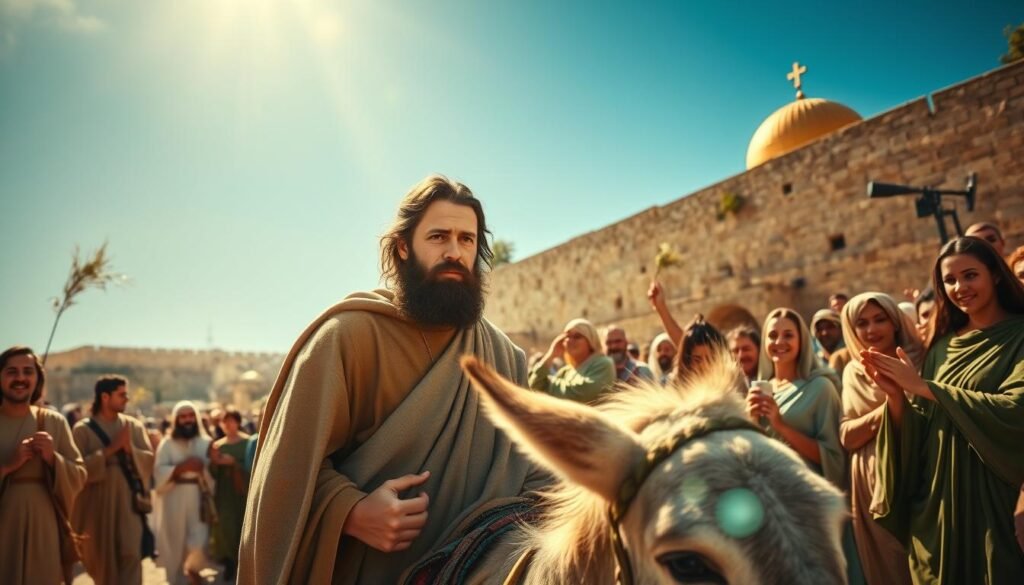
Others cut branches and lined the street, echoing festal processions and Psalm 118’s shouts of welcome. Zechariah’s context reaches beyond Israel to suggest that nations will see a different reign.
This entry marks a pivot: acclaim flows into a path that leads from praise to cross to resurrection. The king’s humility contrasts earthly displays and reframes victory as meekness perfected in sacrifice.
- Royal yet humble arrival fulfills a clear prophecy.
- Public signs—cloaks, branches, shouts—confirm identity.
- The way from welcome to cross ties multiple prophecies together.
“Blessed is he who comes in the name of the Lord!”
Thirty Pieces of Silver and the Potter’s Field
A small sum and a clay field bind a prophetic line to a dramatic betrayal. Zechariah 11:12–13 records a startling detail: “They paid me thirty pieces of silver… ‘Throw it to the potter’.” That exact wording shapes how later writers saw the event.
Prophecy: Zechariah’s charged detail
Thirty pieces of silver served as a vivid price. In ancient terms, that was the value set for a slave, not a king. The prophet’s scene casts the shepherd as undervalued and rejected.
Fulfillment: Matthew’s careful linking
Matthew records Judas accepting silver and later returning it. The religious leaders refuse the coins for the temple treasury, and they buy a potter’s field with that money (Matthew 26:14–15; 27:3–10).
- Exact amount: thirty pieces ties prophecy and act.
- Trajectory: from hands to temple to potter’s field mirrors the prophetic script.
- Gravity: the blood-stained betrayal marks the tragic end of Judas’s arc and exposes leadership judgment.
“I threw the thirty pieces of silver to the potter at the house of the Lord.”
Takeaway: small details—pieces, silver, and place—carry weight. They help readers see how multiple prophecies converge during the passion week and how messiah would be appraised by his own people.
Pierced and Looked Upon: Zechariah’s Vision
Zechariah 12:10 offers a vivid scene: “They will look on me, the one they have pierced,” and mourn like a parent over an only son.
This prophet frames a moment when grief exposes truth. The sight of pierced hands and a wounded man sparks deep conviction among people.
John 19:31–37 links that look to the cross. When a spear pierced his side, blood and water flowed—signs John reads as fulfillment of Zechariah’s line.
Recognition of the name brings repentance. As hearts turn, death gives way to renewed faith and hope.
- Public mourning: sorrow like for an only son draws communities together.
- Spear and signs: blood and water tie prophecy to passion detail.
- Global scope: later scripture says all nations and the whole world will one day look and see.
“They will look on me, the one they have pierced.”
Seen this way, the vision moves from local grief to an eschatological horizon where the messiah would be known and hearts on earth respond.
The New Covenant Promised in Jeremiah
Jeremiah’s vision gives a covenant that changes memory, morals, and communal life. Jeremiah 31:31–34 speaks of a new agreement where the law is written on the heart and sins are remembered no more.
- Internal law: God’s will shapes desires through the spirit, not just rules on stone.
- Definitive forgiveness: sins are dealt with so people can live in restored relation.
- Intimacy: everyone will know God directly, not only by external rite.
Fulfillment in worship and community
Jesus links Jeremiah’s promise to the Lord’s Supper when he calls the cup “the new covenant in my blood.” That word connects sacrifice and forgiveness across Testaments.
Hebrews explains how this covenant is better: the servant obedience secures real cleansing and changed hearts. Early church acts and life grew from that reality, as people shared meals, memory, and mission.
“I will remember their sins no more.”
In this way, messiah would mediate a bond that unites Jew and Gentile so the whole world can know new life under a single, transforming covenant.
Examples Of Prophecies In The Bible That Fix a Timeline
A precise prophetic timetable can read like a clock, counting down to a decisive arrival.
Daniel’s “Seventy Sevens” and the Anointed One
Daniel 9:24–27 lays out seventy sevens — a structured span of years that frames key acts: sin judged, transgression sealed, and righteousness restored. The passage begins with a word to restore Jerusalem and then counts intervals in a clear order.
The timeline points to an anointed one who appears within that span and, as the text says, is then cut off. That phrase supports the idea that messiah would arrive and face death near the scheduled close.
Historical framing: from restoration to the Messiah
This scheme ties local restoration decrees to wider redemption history. It maps political acts and spiritual goals onto measured years.
- Start point: a decree to rebuild — the first marker of the countdown.
- Middle sections: defined intervals that mark key shifts in purpose and punishment.
- End focus: forgiveness, justice, and a sealed vision that completes the plan.
“Seventy sevens are decreed for your people…”
Jesus later appeals to Daniel’s framework, showing that messiah would be read through those pages. That use highlights how time itself is presented as governed by God toward redemption and the final end.
The Rejected Cornerstone Becomes the Foundation
A rejected stone becomes central to God’s plan, reversing human judgment and reordering purpose on earth.
Psalm 118:22–24 names a rock that builders cast aside, yet God makes it the cornerstone. New Testament writers echo that image—Mark, Acts, Ephesians, and 1 Peter—showing how a refused figure is raised to structural primacy.
Human hands misjudge and even cause his death, but those same acts fail to stop God’s design. The builders—people who thought they knew worth—proved mistaken.
The result is a church that spans the earth and unites Jew and Gentile on one foundation. Early preaching used this line to insist there is salvation in no other name, pressing that messiah would be both rejected and exalted.
- Reversal: rejection becomes placement.
- Stability: cornerstone aligns the whole structure.
- Invitation: align your life with the stone rather than stumble over it.
“The stone the builders rejected has become the cornerstone.”
Prophet Like Moses: Mediator and Messenger
Deuteronomy promises a future prophet who will stand between God and people, speaking with Moses’ authority.

This man brings God’s word to daily life and guards the covenant so the community can live without fear of direct wrath.
Scripture and apostolic preaching point to how the messiah would fulfill leader, teacher, and intercessor roles. John’s crowds named him a prophet after signs, and Peter cites Deuteronomy in public acts of proclamation (see Acts references).
Accountability follows: rejecting that messenger meant rejecting God’s claim. The office bridges divine holiness and human need for mercy and clear revelation.
- He speaks God’s voice and applies law to life.
- He mediates sacrifice, teaching, and ruling for a renewed covenant.
- His authority exceeds earlier prophets, uniting priestly and royal tasks.
“A prophet like me will the Lord raise up for you.”
Hear this prophet: in him the nation finds guidance, rescue, and a way to blessing.
Son of Man and Son of God: Authority, Kingdom, and Glory
Daniel’s vision and the royal psalm together frame who will rule and why that rule matters. They present a figure both heavenly and representative, honored by God and given an eternal realm.
Daniel’s divine figure and everlasting dominion
Daniel 7:13–14 pictures “one like a son of man” arriving with the clouds of heaven. This figure receives dominion that does not end, a clear image of enduring rule and divine investiture.
Psalm 2’s royal Son and worldwide inheritance
Psalm 2 calls the anointed one “my Son” and promises the nations as his inheritance. That promise links royal sonship to global authority, showing how earth and world fall under righteous leadership.
How New Testament writers connect these lines:
- Jesus often used the title Son of Man to claim Daniel’s role in his own ministry.
- Luke and other writers interpret royal phrases as fulfilled in Jesus’ life, death, and exaltation.
- Early preaching in Acts applies these texts to his present reign and headship after resurrection.
“One like a son of man came with the clouds of heaven…”
Takeaway: read together, Daniel and Psalm 2 show a messiah would unite divine sonship and human representation. This figure holds power from heaven over nations and earth, invites worship, and sends followers into mission across the world.
Conclusion
Hold this strong, central claim: the matched lines across older texts and later acts create a clear, cumulative case that rewards careful reading.
Stoner’s probability shows how unlikely such convergence is by chance. Key fulfillments—from Bethlehem and Isaiah’s sign to the suffering servant, Psalm 22’s crucifixion details, Psalm 16’s empty tomb, and Daniel’s timeline—form a single thread.
Even small marks, like pieces silver and the potter’s field, add precision. The prophet, priest-servant, and king-son roles unite in that one mission. Follow the way from promise to fulfillment and you’ll find hope and peace for a hurting world.
Study these texts to deepen trust in God’s timing. Respond beyond thought: meet the one who keeps his word to the end and brings lasting hope.
