
Ever thought about the divine messengers in the Bible? They play a big role in our lives. The Angel Gabriel is one such important figure.
The Angel Gabriel is key in the Christmas story. He’s famous in the Bible, next to the Trinity and the devil. His appearances in the Bible are very important, marking big events.
Learning about Gabriel’s role in the Bible can make your faith stronger. As we look into the Angel Gabriel, you’ll see how vital he is in biblical history.
The Divine Messenger: Gabriel’s Biblical Significance
To understand Gabriel’s role, we look at his name, his place among angels, and his role in the Bible. He is a key messenger between heaven and earth.
Gabriel’s Name and Its Hebrew Meaning
Gabriel’s name comes from Hebrew. It means “God is my strength.” This tells us about the angel’s role and character in the Bible. His name shows he is a messenger sent by God.
Gabriel’s Position in the Angelic Hierarchy
Gabriel is seen as a principal angel in the Bible. The exact order of angels is not clear. But his role in Daniel and Luke shows his importance in God’s plan.
First Biblical Appearances of Gabriel
Gabriel first shows up in Daniel, where he explains visions. This sets the stage for his role in delivering messages. In Luke, he announces the births of John the Baptist and Jesus. This shows his key role in salvation.
Looking at Gabriel’s name, position, and Bible appearances helps us understand him better. This deepens our view of the Bible and how messengers help God’s plan unfold.
Who Is the Angel Gabriel in the Bible? 5 Amazing Facts You Need to Know
The Bible tells us about the Angel Gabriel. He is a messenger of God. His story is in both the Old and New Testaments.
Fact 1: Gabriel Is One of Only Two Angels Named in the Bible
Many angels are mentioned in the Bible. But only two are named: Michael and Gabriel. This shows Gabriel’s importance in biblical narratives.
Fact 2: Gabriel Interpreted Daniel’s Apocalyptic Visions
In Daniel, Gabriel helps Daniel understand his visions. Daniel 8:15-26 and Daniel 9:20-27 tell us about this. Gabriel’s role shows he has unique access to divine knowledge.
Fact 3: Gabriel Announced John the Baptist’s Birth to Zechariah
Gabriel told Zechariah about John the Baptist’s birth. This is a key moment in the New Testament. Luke 1:11-20 tells us about this.
Fact 4: Gabriel Delivered the Annunciation to the Virgin Mary
Gabriel’s visit to Mary is famous. He told her she would have Jesus. Luke 1:26-38 shares this important event.
Fact 5: Gabriel’s Appearances Highlight His Role as a Divine Messenger
Gabriel’s role is clear in the Bible. He interprets visions and announces births. He is a faithful servant of God.
These five facts show Gabriel’s big role in the Bible. As a messenger, his appearances are filled with importance and respect. He is a key figure in biblical studies.
Gabriel’s Pivotal Role in the Old Testament
Gabriel is a key figure in the Old Testament. He is a divine messenger to Daniel. This shows Gabriel’s importance in biblical stories, mainly in the book of Daniel.
Gabriel’s Appearances to the Prophet Daniel
Gabriel talks to Daniel in important moments in the Old Testament. In Daniel 8:15-27 and Daniel 9:20-27, Gabriel helps Daniel understand his visions. These talks show Gabriel’s role as an interpreter of divine mysteries.
The first time Gabriel talks to Daniel is in Daniel 8. He explains the vision of the ram and the goat. This helps Daniel know about future conflicts between Media-Persia and Greece. It shows the significance of Gabriel’s role in biblical prophecy.
Gabriel as Interpreter of Divine Mysteries
Gabriel does more than just explain visions. He connects the divine and human worlds. By explaining divine mysteries to Daniel, Gabriel helps people understand God’s plans. This interpretive role is key in the biblical story.
In Daniel 9, Gabriel comes back to explain the prophecy of the seventy weeks. This is very important because it talks about the coming of the Messiah. It shows the importance of Gabriel’s messages in biblical eschatology.
Gabriel’s talks with Daniel show his big role in the Old Testament. He is a messenger and interpreter of God’s will. His talks with Daniel show how important angelic mediation is in understanding divine revelation.
Gabriel’s Crucial Messages in the New Testament
The angel Gabriel is very important in the New Testament. He brings messages that change the story of salvation. You’ll see how Gabriel’s messages tell us about Jesus Christ and the faith of those who heard them.
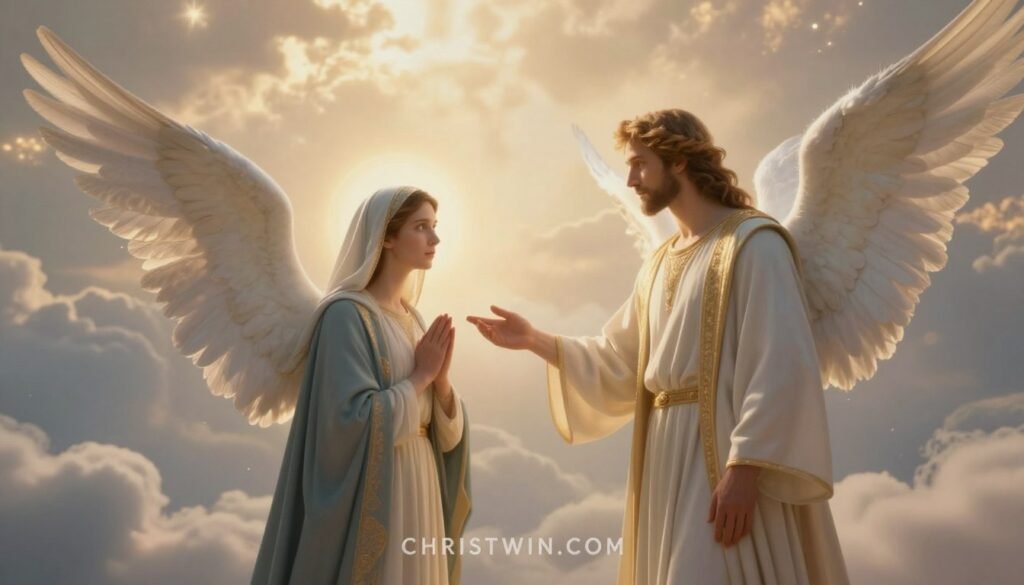
The Announcement to Zechariah in the Temple
Gabriel appeared to Zechariah, John the Baptist’s father, in the Temple. This was a big moment for Jesus’ coming. It happened while Zechariah was doing his priestly duties.
Gabriel told Zechariah that his wife, Elizabeth, would have a son named John. John would get ready for the Lord. Zechariah doubted because of their age. But Gabriel said he was in God’s presence, and it was true.
This shows Gabriel’s role as a messenger. He brings news that might seem hard to believe but shows God’s power and plan.
The Annunciation to Mary in Nazareth
Gabriel’s visit to Mary is very famous. It’s in Luke 1:26-38. Gabriel said, “Hail, full of grace, the Lord is with you!” This was a greeting and a sign of her special status.
Gabriel told Mary she would have a son, Jesus. He would be the Son of the Most High and rule on David’s throne. Mary said, “Let it be to me according to your word.” This shows her faith and acceptance of God’s will.
Gabriel’s messages to Zechariah and Mary show the importance of faith and obedience. These stories highlight Gabriel’s role as a divine messenger. They also show the value of trusting in God’s promises, even when they seem impossible.
The Theological Significance of Gabriel as God’s Messenger
Gabriel is very important because he talks to God and then shares messages with us. His role in the Bible shows us how vital his messages are. They help us understand God’s plan.
Gabriel’s Special Access to the Divine Presence
Gabriel can talk to God, which makes him very special. In the book of Daniel, he talks to Daniel about important visions. This shows Gabriel’s special access to the divine presence.
Gabriel’s job is not just to share messages. He does it with God’s direct permission. This makes his role very important in the Bible, showing God’s direct involvement.
Gabriel’s Messages and Their Impact on Salvation History
Gabriel’s messages are key in the Bible, shaping our understanding of salvation. His announcement to Mary about Jesus is a big moment in Christian history (Luke 1:26-38). It shows the role of faith and divine intervention.
He also tells Zechariah about John the Baptist’s birth (Luke 1:11-20). This prepares the way for Jesus. These moments show how Gabriel’s messages are linked to salvation history. They connect the divine and human worlds.
In summary, Gabriel’s role as God’s messenger is deep and meaningful. His access to God and the impact of his messages are key. They show how God interacts with us, blending divine power with human experience.
Gabriel in Christian Tradition and Theology Through the Ages
Gabriel’s role in Christian tradition is rich and deep. It spans many centuries. Different Christian groups see Gabriel in different ways, showing the complexity of faith.
Gabriel in Early Church Writings
In early Christian texts, Gabriel is seen as a messenger of God. He brings important messages. The early Church Fathers saw him as key in the story of salvation.
Church Fathers like Origen and Jerome wrote about Gabriel. They saw him as an archangel. They believed he was important in the heavenly world and in sharing God’s messages with people.
Gabriel in Catholic and Orthodox Traditions
In Catholic and Orthodox traditions, Gabriel is a saint. He is known as the Archangel Gabriel. These traditions highlight his role in the Incarnation, like the Annunciation to Mary.
The Catholic Church sees Gabriel as the patron of messengers and postal workers. This shows his role as a divine messenger. In Orthodox tradition, Gabriel is also celebrated on March 26.
Gabriel in Protestant Understanding
In Protestant traditions, views on Gabriel vary. Some see him as an archangel, while others do not. Protestant theologians focus on Gabriel’s roles in the Bible, like in the annunciation stories.
Some Protestants see Gabriel as a symbol of God’s presence. They believe he shows God’s direct action in the world. This view emphasizes the direct bond between God and people, with Gabriel as a messenger.
Gabriel (Jibril) in the Quran and Islamic Tradition
In Islam, Gabriel, or Jibril, is very important. He helped bring the Quran to Muhammad. This shows how key Jibril is in Islam.
The Role of Jibril in Revealing the Quran
Jibril helped Muhammad get the Quran over 23 years. This started when Muhammad was in the Cave of Hira. Jibril first showed up to him there.
The Quran’s revelation was not just simple text; it was a deep process. Jibril recited verses to Muhammad, who memorized them. This kept the Quran safe.
Similarities and Differences Between Biblical and Quranic Portrayals
Both the Bible and Quran talk about Gabriel as a key angel. They both see him as a messenger of God. But, the Quran mainly talks about Jibril’s role in revealing the Quran.
Both traditions see Gabriel/Jibril as a divine messenger, but they tell different stories about him. Knowing these differences helps us understand Gabriel/Jibril’s role better.
Artistic and Cultural Depictions of Gabriel Throughout History
The angel Gabriel has been a timeless figure in human imagination. He has inspired countless artistic expressions throughout history. Gabriel’s appearances in the Bible and other religious texts have made him a central figure in various cultural and artistic representations.
Gabriel in Medieval and Renaissance Art
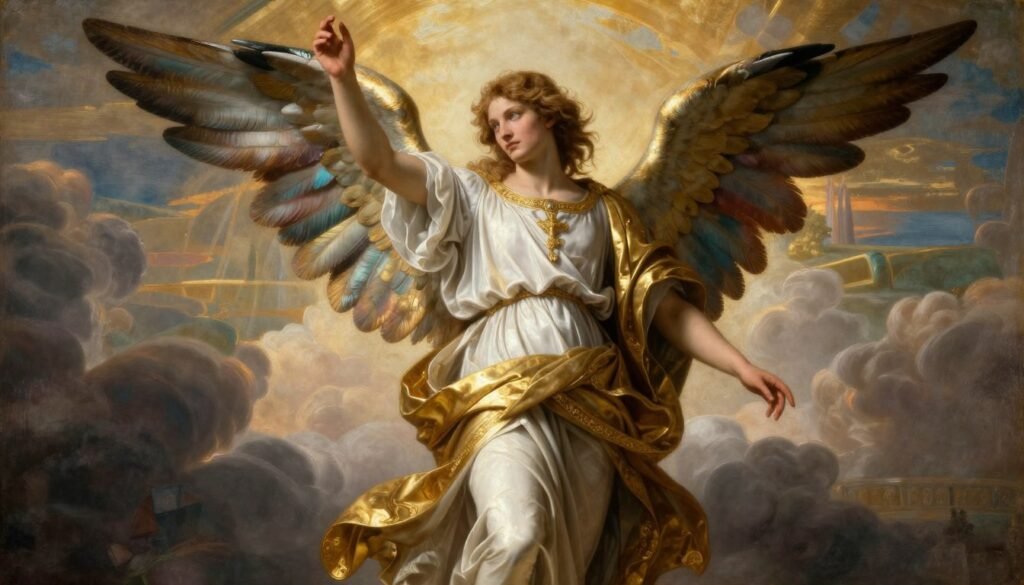
In the medieval and Renaissance periods, Gabriel was often depicted in art. He was shown as a majestic being, usually with wings. This symbolized his divine presence and messenger role.
Artists like Leonardo da Vinci and Fra Angelico portrayed Gabriel. They showed him in scenes of the Annunciation. In these scenes, Gabriel announces to the Virgin Mary that she will bear Jesus.
Key artistic elements associated with Gabriel include:
- Lily or other flowers, symbolizing purity
- Wings, representing divine nature
- A halo or aura, signifying holiness
- Sometimes depicted with a scepter or scroll, indicating his role as a messenger
Gabriel in Literature, Music, and Modern Media
Gabriel’s influence extends beyond visual arts into literature and music. In literature, Gabriel has been a character or inspiration in numerous works. This includes John Milton’s Paradise Lost and more contemporary writings.
In music, Gabriel is often referenced in hymns and religious compositions. He symbolizes hope and divine intervention.
In modern media, Gabriel continues to be a popular figure. He appears in films, television shows, and books. Often, he is shown as a guide or messenger between the divine and human realms.
These representations keep Gabriel relevant in contemporary culture. They adapt his ancient role to modern storytelling.
As we explore Gabriel’s presence in art and culture, we see his enduring impact. He continues to inspire creativity and faith across centuries. Gabriel remains a powerful symbol of divine communication.
Common Misconceptions About the Angel Gabriel
The Angel Gabriel is often misunderstood. It’s time to set the record straight about his role in biblical narratives. Many people believe things about Gabriel that aren’t true. Let’s look at some of these misconceptions and what the Bible really says.
Is Gabriel Actually Called an Archangel in the Bible?
Many think Gabriel is called an archangel in the Bible. But, the Bible only uses the term “archangel” once. This is in 1 Thessalonians 4:16, talking about “the archangel’s voice.” Gabriel is not directly called an archangel in the Bible. Yet, he is often seen as one because of his big roles in the Old and New Testaments.
The biblical reference to “the archangel” in 1 Thessalonians is generally understood to refer to Michael, not Gabriel. But Gabriel’s importance is shown through his talks with key figures like Daniel and Mary.
Gabriel’s Gender and Physical Appearance in Scripture
Another misconception is about Gabriel’s gender and looks. The Bible doesn’t give us a clear picture of Gabriel’s appearance. It calls him a “man” (Daniel 9:21) or an “angel,” but doesn’t describe him physically. This shows Gabriel’s spiritual role is more important than his looks.
It’s surprising to learn the Bible doesn’t say angels, including Gabriel, have a gender. Gabriel is called “he” but this doesn’t mean he has a human gender. His role as a messenger of God is what matters, not his looks.
Gabriel’s Horn and Other Popular Misattributions
Some pictures show Gabriel with a horn, like in scenes of the Annunciation. But, there’s no biblical reason for this. The horn isn’t mentioned in the story of the Annunciation (Luke 1:26-38). This idea likely came from art that mixed biblical and cultural ideas over time.
Gabriel isn’t linked to any specific object or attribute in the Bible. His role is shown by his actions and messages, not by symbols or objects.
By understanding these misconceptions and what the Bible really says about Gabriel, we can appreciate him more. He plays a big role in biblical stories.
Gabriel Compared to Other Biblical Angels
Gabriel is a key angel in the Bible. Looking at his role with other angels shows how God talks to us. Angels are messengers and do God’s work, each in their own way.
Gabriel and Michael: Contrasting Roles and Missions
Gabriel and Michael are two named angels in the Bible. They play different parts in the heavenly host. Michael fights against evil, while Gabriel brings important messages.
Michael battles evil, like in Daniel and Revelation. But Gabriel helps and guides, like with Daniel and Mary. This shows God uses different angels to talk to us.
Gabriel’s Unique Function Among the Heavenly Host
Gabriel is special because he brings messages from God. He explains big prophetic messages, like to Daniel. This shows how important it is to understand God’s words.
Gabriel also played a big part in Jesus’ birth. His work in both the Old and New Testaments shows God’s message never stops. Angels help share this message.
In short, Gabriel is different from other angels, like Michael. His job as a messenger is key. It shows how God talks to us in many ways.
Conclusion: The Enduring Legacy of Angel Gabriel
You’ve learned about Angel Gabriel’s big role in the Bible and Christian beliefs. Gabriel is a key messenger in the Bible. He is one of only two angels named, showing his big importance.
Gabriel’s messages to Daniel, Zechariah, and Mary are very important. They show how Gabriel helps share God’s plan. He is important in both the Old and New Testaments.
Gabriel’s lasting messages show his big impact. Thinking about Gabriel reminds us of the power of faith. His story helps us grow spiritually and understand God’s plan better.
Learning about Gabriel helps us see more of Christian beliefs and angels in the Bible. This knowledge can make our faith stronger and help us appreciate Gabriel’s story more.
