
Have you ever thought about what Jesus meant when He said, “I am the Bread of Life“? This important saying, found in John 6:35, helps us understand Jesus’ role in our spiritual lives.
Jesus said He is the Bread of Life. This means He gives us spiritual food. Just like bread feeds our bodies, Jesus feeds our souls. He offers us eternal life through Him.
Looking into the significance of Bread of Life in the KJV Bible shows us more about Jesus’ teachings. By studying the Bible’s context and related verses, we learn more about Jesus’ message. This helps us on our faith journey.
Understanding “I Am the Bread of Life” Meaning KJV
The KJV version of John 6:35 says, “I am the bread of life; whoever comes to me shall not hunger, and whoever believes in me shall never thirst.” This verse is key to understanding Jesus’ message. It’s important to look at the KJV translation and compare it with other versions. This helps us understand the biblical context and how it applies to our lives.
Word-by-Word Analysis of the KJV Translation
Let’s look at John 6:35 in the KJV: “I am the bread of life; whoever comes to me shall not hunger, and whoever believes in me shall never thirst.” The phrase “I am” shows Jesus’ divinity. “The bread of life” means Jesus is the source of spiritual food.
“Whoever comes to me shall not hunger” means coming to Jesus satisfies our spiritual hunger. “Whoever believes in me shall never thirst” shows believing in Jesus quenches our spiritual thirst. This verse says Jesus is the ultimate source of spiritual fulfillment.
Comparing KJV with Other Bible Translations
Looking at different Bible translations helps us understand “bread of life” better. For example, the New International Version (NIV) says John 6:35 like this: “Jesus declared, ‘I am the bread of life. Whoever comes to me will never go hungry, and whoever believes in me will never be thirsty.'” Even though the message is the same, different words can give us new insights.
The Amplified Bible (AMP) gives a detailed version: “Jesus said to them, ‘I am the Bread of Life; he who comes to Me will never hunger, and he who believes in Me will never be thirsty.'” This version highlights the ongoing act of coming to Jesus and believing in Him.
By looking at different translations, we can understand Jesus’ statement better. It shows how it is important in our lives.
The Historical Significance of Bread in Biblical Times
In the biblical era, bread was more than food. It showed God’s care for His people. We see its importance in ancient Israel and Jewish tradition.
Bread as a Staple Food in Ancient Israel
Bread was key in ancient Israel’s diet. It came from grains like barley and wheat. Making bread was hard work, from grinding grain to baking it.
The Bible talks about bread a lot. It was a main food. For example, during Passover, the Israelites made unleavened bread to remember leaving Egypt.
Key aspects of bread in ancient Israel include:
- Daily sustenance: Bread was a mainstay of the daily diet.
- Religious rituals: Bread played a critical role in religious ceremonies.
- Cultural practices: Baking and sharing bread were key to community life.
Cultural Symbolism of Bread in Jewish Tradition
Beyond being food, bread had deep meaning in Jewish tradition. It stood for hospitality, peace, and God’s blessings. Breaking bread welcomed and united people.
In Jewish culture, bread meant shalom (peace). It showed God’s care. The Sabbath bread, or Challah, symbolized the extra manna the Israelites found in the desert.
The cultural symbolism of bread is reflected in several ways:
- Hospitality: Sharing bread welcomed and showed friendship.
- Divine provision: Bread showed God’s care and provision.
- Community: Baking and sharing bread united people.
Learning about bread’s role in biblical times deepens our understanding. It shows bread’s importance as a basic need and a symbol of spiritual truths.
The Theological Implications of Jesus as Bread
“I am the Bread of Life” is more than a saying. It’s a deep truth that changes how we see spiritual food. Jesus’ words ask us to think deeply about His role as our spiritual food.
Sustenance for Spiritual Life
Jesus is the Bread of Life, meaning He is our main spiritual food. Just like our bodies need food, our spirits need Jesus to live well. This idea is key for those wanting to grow their faith and connect with God.
Key aspects of Jesus as spiritual sustenance include:
- Providing spiritual nourishment that satisfies our deepest longings
- Offering a connection to God that is both personal and profound
- Guiding us through life’s challenges with divine wisdom
By seeing Jesus as the Bread of Life, we start a deeper spiritual journey. This journey brings us peace, purpose, and happiness.
Connection to Manna in the Wilderness
The meaning of Jesus as the Bread of Life is also tied to the manna in the wilderness. In Exodus, manna was a miracle food for the Israelites, keeping them alive on their journey.
The parallels between manna and Jesus as Bread of Life are striking:
- Manna was a divine gift, showing God’s care for His people.
- Jesus, as the Bread of Life, is a spiritual gift that goes beyond just food.
- Both manna and Jesus meet our deepest needs, whether for food or for our souls.
Seeing this connection helps us understand Jesus’ role in our lives. It shows how the Old Testament’s food and the New Testament’s Jesus are connected.
The Seven “I Am” Statements in John’s Gospel
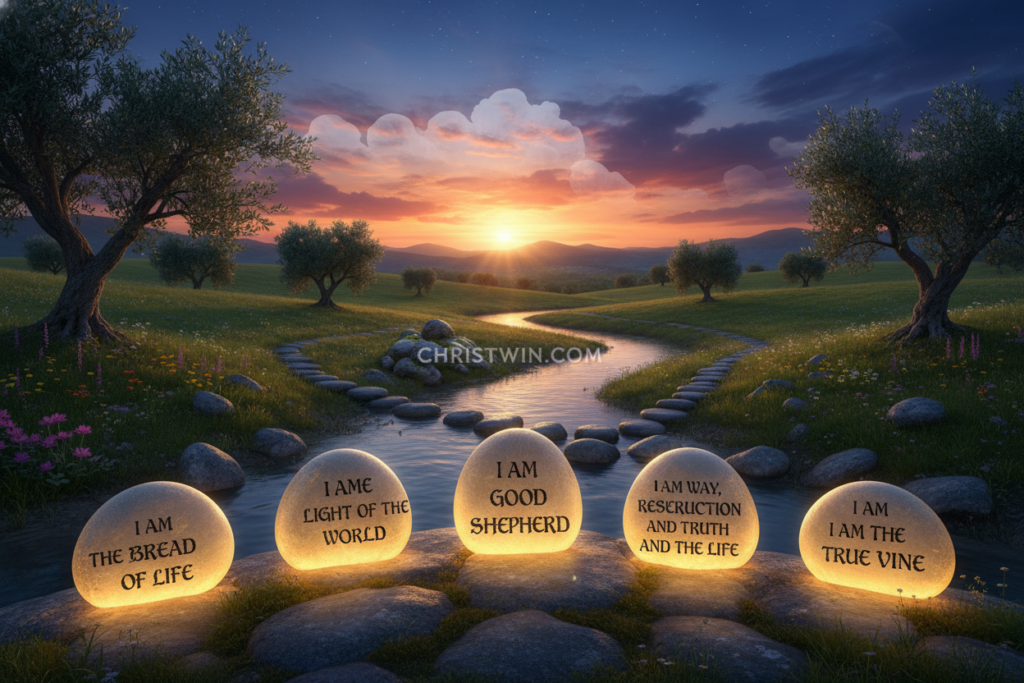
The Gospel of John has seven “I Am” statements from Jesus. Each one shows a different part of who He is. These sayings are deep revelations of Jesus’ identity and mission.
Overview of All Seven Declarations
Jesus made seven “I Am” statements in John’s Gospel. They are:
- “I am the Bread of Life” (John 6:35)
- “I am the Light of the World” (John 8:12)
- “I am the Door of the Sheep” (John 10:7, 9)
- “I am the Good Shepherd” (John 10:11, 14)
- “I am the Resurrection and the Life” (John 11:25)
- “I am the Way, the Truth, and the Life” (John 14:6)
- “I am the True Vine” (John 15:1, 5)
Each statement gives a special view of Jesus’ nature and role. Together, they show His divine identity fully.
How “Bread of Life” Fits into the Larger Pattern
The “I am the Bread of Life” statement is key. It shows Jesus as the source of spiritual life. This sets the stage for the other “I Am” statements.
Seeing the “Bread of Life” statement with the others reveals Jesus’ message. It’s not just about spiritual food. It’s about guidance, protection, and eternal life through Jesus.
Connection to the Last Supper and Communion
Jesus said, ‘I am the bread of life.’ This is very meaningful when we think about the Last Supper and communion. It’s not just a coincidence. It’s a special thread in Jesus’ story, as told in the Gospels.
The Last Supper is a big event in Christian history. Jesus started communion there. He took bread, said thanks, and said, “This is my body, which is given for you. Do this in remembrance of me” (Luke 22:19, NIV). This act and words made a new covenant, linking bread to Jesus’ sacrifice.
Bread as Christ’s Body in Communion
In communion, bread stands for Christ’s body, just like Jesus said. It’s not just a figure of speech. It’s a real spiritual truth. When we take communion, we connect with Jesus’ sacrifice and resurrection.
Bread in communion reminds us of Jesus’ presence. It shows the nourishment Jesus gives us. This is like what Jesus talked about in John 6, being the bread of life.
Ongoing Spiritual Nourishment Through Sacrament
Communion gives us spiritual food every time we take it. It reminds us of Jesus’ sacrifice. It’s like the manna the Israelites ate in the desert. This food is key for our spiritual journey, giving us strength and comfort.
When we take communion, we connect deeply with Jesus. This connection is at the heart of our faith. It brings us together as a community, sharing a spiritual experience.
The link between Jesus as the “bread of life” and communion shows the heart of our faith. It shows how important communion is for our spiritual growth.
The Promise of Eternal Life in the Bread of Life Discourse
In the bread of life discourse, Jesus shares a big promise. He says eternal life is for those who “eat this bread” and believe in Him. This is more than a simple statement. It’s an invitation to a special relationship with God.
Exploring this discourse, we see Jesus’ promise is rich. It’s not just about future hope. It’s about a life-changing reality for believers today.
Jesus’s Promises to Those Who “Eat This Bread”
Jesus says, “I tell you, unless you eat the flesh of the Son of Man and drink his blood, you have no life in you” (John 6:53). This statement is often hard to understand. But it’s key to grasp it in its biblical setting. Eating Jesus’ flesh and drinking His blood mean believing in Him and accepting His life.
For those who “eat this bread,” Jesus offers eternal life. This life is not just long. It’s a life of quality, starting now and lasting forever. It’s a life filled with a deep, personal bond with God through Jesus Christ.
Understanding Eternal Life in Biblical Context
Eternal life, in the Bible, is more than just living forever. It’s a divine life. It begins when one believes in Jesus Christ and lasts forever, filled with God’s love and grace.
The bread of life discourse shows eternal life is both a future promise and a present reality. Believers live this life now through faith. It helps them face life’s challenges, giving them hope and assurance.
In conclusion, the promise of eternal life in the bread of life discourse is central to Christian faith. It highlights God’s deep love and the gift of eternal life through Jesus Christ.
Common Misinterpretations of the Bread of Life Passage
Exploring the Bread of Life passage is like walking through a world of many views. You’ll find different ideas that help you understand Jesus’s words, “I am the Bread of Life.”
Literal vs. Metaphorical Interpretations
There’s a big debate about what Jesus meant. Some think he meant to eat his body. But most see it as a call to believe in Christ for spiritual food.
This debate is about Jesus’s role in our lives. Seeing it as a metaphor means faith and connection with Christ are key, not eating his body.
Key considerations in this debate include:
- The cultural context of Jesus’s teachings
- The symbolic significance of bread in biblical narratives
- The theological implications of consuming Christ’s body
Addressing Theological Controversies
The Bread of Life passage has sparked big debates. One big one is about transubstantiation, a topic in Catholic and Protestant churches.
There’s a big argument about the Lord’s Supper. Different churches have different ideas about Christ’s presence in the bread and wine. Knowing these differences helps us see how Jesus’s words are understood in many ways.
- Catholic Perspective: They believe bread and wine become Christ’s body and blood.
- Protestant Perspectives: They have different views, like consubstantiation and seeing it as symbolic.
Thinking about these debates can make you see the Bread of Life passage in a new light. It can deepen your faith journey.
Practical Applications for Christian Living
The Bread of Life metaphor is a key to better Christian living. It helps us understand Jesus’ teachings better. We can use these teachings in our daily lives.
Finding Spiritual Nourishment in Christ
Our spirits need nourishment, just like our bodies need food. Jesus is the Bread of Life, giving us this nourishment. To get it, we must pray, read scripture, and be with other believers.
Daily devotions help us grow closer to Christ. Set aside time each day for Bible reading and prayer. This strengthens our bond with Him and helps us face life’s challenges.

Living Out the Bread of Life Metaphor
Living the Bread of Life metaphor is more than personal growth. It’s about how we treat and help others. We must share our blessings like bread is shared.
Helping others in our community is a practical way to live this metaphor. Volunteer at food banks or help neighbors. This shows Jesus’ love and compassion.
- Practice generosity by sharing your time, talents, and resources with others.
- Cultivate a spirit of gratitude by recognizing the blessings in your life.
- Seek opportunities to serve others, whether in your church, community, or workplace.
By following these steps, we can live the Bread of Life metaphor. We bring hope and nourishment to those around us.
Modern Relevance of the Bread of Life Metaphor
The bread of life metaphor is very important today. It talks about our deep spiritual hunger. In our busy world, we all look for meaning and purpose.
This metaphor helps us understand Jesus’ role in our lives. It shows how he can fill our spiritual needs.
Addressing Spiritual Hunger in Today’s World
Spiritual hunger is something we all feel. It doesn’t matter where we come from or what we believe. In today’s world, many people feel empty and disconnected.
The bread of life metaphor is a powerful symbol. It reminds us of the need for spiritual nourishment and renewal.
Think about your spiritual journey. How does the bread of life metaphor relate to Jesus in your life? It might give you a new way to see how Christ supports you.
- The bread of life metaphor emphasizes Jesus’ role as a source of spiritual sustenance.
- It highlights the importance of cultivating a deep and personal relationship with Christ.
- This metaphor encourages believers to seek spiritual nourishment through prayer, scripture, and community.
The Bread of Life in Contemporary Christian Thought
In today’s Christian thought, the bread of life metaphor is very important. It’s often talked about when discussing the Lord’s Supper and spiritual nourishment. It helps us understand Jesus’ teachings better.
This metaphor also shapes discussions on social justice and community. By looking at Jesus’ words through today’s lens, we can better live our faith.
Key aspects of the bread of life metaphor in contemporary Christian thought include:
- Its emphasis on the personal and relational aspects of faith.
- The connection between spiritual nourishment and communal practice.
- The ongoing relevance of Jesus’ teachings in addressing contemporary challenges.
Conclusion
You’ve learned about Jesus’ important saying, “I am the bread of life.” It’s not just a figure of speech. It shows who Jesus is and what He came to do. Thinking about this helps you see Jesus as the source of spiritual food.
The talk about bread of life is deep and interesting. It shows Jesus’ role in feeding our souls. As you keep growing spiritually, get closer to Jesus. See Him as your bread of life. This means understanding and living His teachings every day.
Seeing Jesus as your bread of life brings you closer to Him. You feel His presence and live your faith truly. Let Jesus’ words guide and inspire you as you go on.
