

Have you ever thought about Judas Iscariot, one of Jesus’ twelve apostles? His betrayal of Jesus has led to a lot of debate and curiosity about his afterlife.
Ray Comfort says, “So, did Judas go to Hell? It seems that way.” This statement starts our journey into Judas’s fate. As we look into the Bible, we’ll see what it says about Judas’s actions and their results.
Knowing Judas’s story is key for Christian believers. It shows us the value of being faithful and the dangers of betrayal. In this article, we’ll dive into the Bible’s account and different views on Judas’s fate. We aim to give you a full look at his afterlife.
The Biblical Account of Judas Iscariot
Judas Iscariot was a complex character in the Bible. He was one of Jesus’s twelve closest followers. His actions show us the depth of human nature and God’s plan.
Judas’s Role Among the Twelve Disciples
Judas was more than just a follower. He was in charge of the group’s money. This is shown in John 12:6.
His Position as Treasurer
As treasurer, Judas managed the group’s money. He had a big role in Jesus’s ministry. But, he also stole from the group’s funds, as John 12:6 tells us.
Mentions of Judas in the Gospels
Judas is talked about in all four Gospels. Each one gives us a different view of him. His betrayal of Jesus was a key event in the story.
Looking at Judas’s story helps us understand Jesus’s time. It shows us the struggle between good and evil. And the importance of staying true to our values.
The Betrayal of Jesus
Have you ever thought about why Judas betrayed Jesus? The story is complex, with many reasons and big effects on Judas and the other disciples.
The Thirty Pieces of Silver
Matthew 26:14-16 tells us Judas sold Jesus for thirty pieces of silver. This was more than a deal; it was a prophecy come true (Zechariah 11:12-13). The thirty pieces of silver showed how much Jesus was worth.
The Kiss of Betrayal
The kiss of betrayal is a sad moment. In Luke 22:47-48, Judas kissed Jesus, thinking it was a sign of friendship. But it was a betrayal. Jesus knew and was sad.
Jesus’s Predictions About His Betrayer
At the Last Supper, Jesus talked about his betrayer. In John 13:21-30, he said one of them would betray him. He gave Judas a piece of bread, showing he knew who it was.
The Last Supper Dialogue
The Last Supper was full of deep talks. Jesus told Judas to do what he was going to do quickly (John 13:27). This showed Jesus understood what was happening.
Thinking about these moments, we see how complex humans are and God’s plan. Judas’s betrayal was a sad event but led to saving humanity.
- The betrayal was a prophecy.
- Jesus knew about the betrayal.
- Judas’s actions had big consequences.
Understanding Judas’s betrayal helps us see loyalty, the effects of our choices, and God’s love for us.
Biblical Descriptions of Judas’s Character
Judas Iscariot is a mix of good and bad. He was devoted but also betrayed. His story in the Bible is complex, showing his role among Jesus’ followers.
References to Judas as a Thief
In John 12:6, Judas is called a thief. He took money from the group’s box. This shows he had a problem with money.
Satan Entering Judas
Satan entered Judas, as Luke 22:3 says. This happened at the Last Supper, before he betrayed Jesus. It shows Judas’s actions were not just his own.
The Question of Judas’s Motivations
Why did Judas betray Jesus? Was it for money or something deeper? The Bible hints at Satan’s role. Think about Judas’s story and the spiritual battles he faced.
Judas’s story teaches us about faith, temptation, and redemption. It shows the spiritual struggles even Jesus’ closest followers had.
The Death of Judas in Scripture
The stories of Judas’s death in the Bible are interesting and complex. The New Testament tells us two different ways Judas died. These stories are found in Matthew and the Acts of the Apostles.
Matthew’s Account of Judas’s Suicide
Matthew 27:5 says Judas hanged himself. He felt bad for betraying Jesus and gave back the money. Then, he hanged himself.
This story shows Judas was truly sorry. But, it also makes us wonder if he really changed.
Acts’ Description of Judas’s Death
Acts 1:18-19 tells a different story. It says Judas bought a field with his betrayal money. Then, he fell and his insides came out.
This version is seen as more violent. Some think it shows God’s anger at Judas.
Reconciling the Different Accounts
It’s hard to make these stories match up. Scholars have tried to find a way. Some say Judas hanged himself and then fell.
Others think the stories are just different ways of saying the same thing. Or, they might come from different groups in the early church.
The Field of Blood
Both stories talk about a field called the “Field of Blood.” In Matthew 27:6-8, the chief priests buy it with Judas’s money. It becomes a place for foreigners to be buried.
This field is important because it ties to old prophecies. It shows what happened because of Judas’s actions.
Looking into Judas’s death helps us understand sin, regret, and forgiveness. These stories give us a deeper look into the Bible’s teachings.
Did Judas Go to Heaven or Hell According to the Bible?
To figure out if Judas was saved or damned, we need to look at the Bible. It gives us clues about Judas’s fate. These clues help us understand what the Bible says about his eternal destiny.
Direct Biblical Statements About Judas’s Fate
The Bible doesn’t say directly if Judas was saved or damned. But it does tell us about his actions and their results. For example, Matthew 27:3-5 talks about Judas’s guilt and his death by hanging himself.
Some scholars think Judas’s betrayal was meant to happen. They point to Psalm 41:9 and John 13:18. These verses show Judas’s actions were part of a bigger plan.
Jesus’s Words About “the Son of Perdition”
In John 17:12, Jesus calls Judas “the son of perdition.” This means Judas was on a path to destruction. The term “son of perdition” also appears in 2 Thessalonians 2:3 to describe someone destined for destruction.
Jesus’s words suggest Judas was heading towards destruction. But it’s important to remember, this doesn’t mean Judas was doomed without choice.
Analyzing Psalm 69 and 109 as Prophetic References
Psalms 69 and 109 are seen as hints about Judas’s fate. They mention verses that seem to predict Judas’s betrayal. For instance, Psalm 69:25 and Psalm 109:8 are linked to Judas in Acts 1:20.
Looking at these psalms helps us understand Judas’s betrayal. They show his actions were part of a bigger story, one that was told and lived out in Jesus’s life.
In conclusion, the Bible doesn’t clearly say if Judas went to heaven or hell. But it gives us clues through direct statements and prophetic references. These clues help us understand the Bible’s view of Judas’s eternal destiny.
The Concept of Forgiveness in Christianity
Exploring forgiveness in Christianity shows us God’s mercy and grace. Forgiveness is key in Christian faith. It helps us understand Judas’s actions and their effects.
God’s Mercy and Grace
Christianity says God’s mercy and grace are at His core. God’s mercy is His kindness to us. His grace is the favor He gives us without asking. The Bible tells many stories of God’s mercy and grace.

Limits to Forgiveness?
Christianity teaches forgiveness is very important. But the Bible also talks about forgiveness limits. Jesus taught us to forgive a lot, like in the parable of the unforgiving servant (Matthew 18:21-35).
But, the Bible says there’s an unforgivable sin, like blaspheming the Holy Spirit (Matthew 12:31-32). This makes us think about forgiveness’s limits.
The Process of Repentance and Redemption
Repentance and redemption are big parts of forgiveness in Christianity. Repentance means turning away from sin and towards God. Redemption means getting back to a good relationship with God through Jesus.
Judas’s story makes us think about his remorse and if it was too late for redemption. Understanding forgiveness in Christianity helps us see Judas’s story. It also makes us think about our own forgiveness and repentance.
As you grow in your faith, think about how these ideas apply to you and your relationships.
The Unforgivable Sin and Judas
It’s key to know about the unforgivable sin to understand Judas’s betrayal. The Bible talks about a sin that can’t be forgiven. This is important for seeing Judas’s actions clearly.
What Constitutes the “Unpardonable Sin”
The Bible says the unforgivable sin is blasphemy against the Holy Spirit (Matthew 12:31-32). This sin is unforgivable because it’s a choice to reject God’s grace and forgiveness through the Holy Spirit.
Now, you might ask if Judas’s betrayal was this sin. To figure this out, we need to look at what Judas did and his heart at the time.
Did Judas Commit Blasphemy Against the Holy Spirit?
Judas’s betrayal is seen as a big sin. But was it blasphemy against the Holy Spirit? This is a topic of debate among theologians.
Some think Judas’s hard heart was a form of blasphemy. Others believe Judas’s remorse and return of the silver coins show he might not have committed this sin.
Despair as a Spiritual Danger
Judas’s story shows the spiritual danger of despair. He chose to die instead of seeking forgiveness or making things right. This shows deep hopelessness.
As Christians, we must share hope and redemption. Judas’s story warns us against letting guilt and shame lead to despair. It shows the need to seek forgiveness and healing.
Thinking about Judas’s actions and their effects reminds us to stay spiritually alert. We must keep God’s love and forgiveness close to our hearts.
Theological Perspectives on Judas’s Salvation
Exploring Judas’s salvation shows many views. The story of Judas Iscariot has sparked many thoughts. People and theologians have different ideas about his fate.
Catholic Views on Judas’s Fate
The Catholic Church has a complex view of Judas. They say his betrayal was very bad. But, some think his sorry might have helped him.
The Church believes in God’s mercy. Yet, they also see Judas’s actions as very serious.
Protestant Interpretations
Protestants have many views on Judas. Some say his betrayal was meant to happen. But, he was also to blame.
Others doubt if Judas really changed his ways. The Protestant Reformation led to many opinions. Some see Judas as a sad figure, others as lost forever.
Eastern Orthodox Perspectives
The Eastern Orthodox Church sees Judas’s story as a mystery. They think about God’s judgment a lot. Orthodox theologians see Judas’s actions as complex.
They believe Judas’s story warns us. It shows the need for repentance and faith.
Modern Theological Reassessments
Today, theologians see Judas in a new light. They think he was more than just a traitor. They look at his actions in the context of Jesus’s time.
Some explore why Judas might have betrayed Jesus. They try to understand him better.
Comparing Judas and Peter’s Failures
The stories of Judas and Peter teach us about guilt, remorse, and redemption. Both failed Jesus in big ways. Yet, their paths show us different lessons on finding redemption.
Betrayal vs. Denial
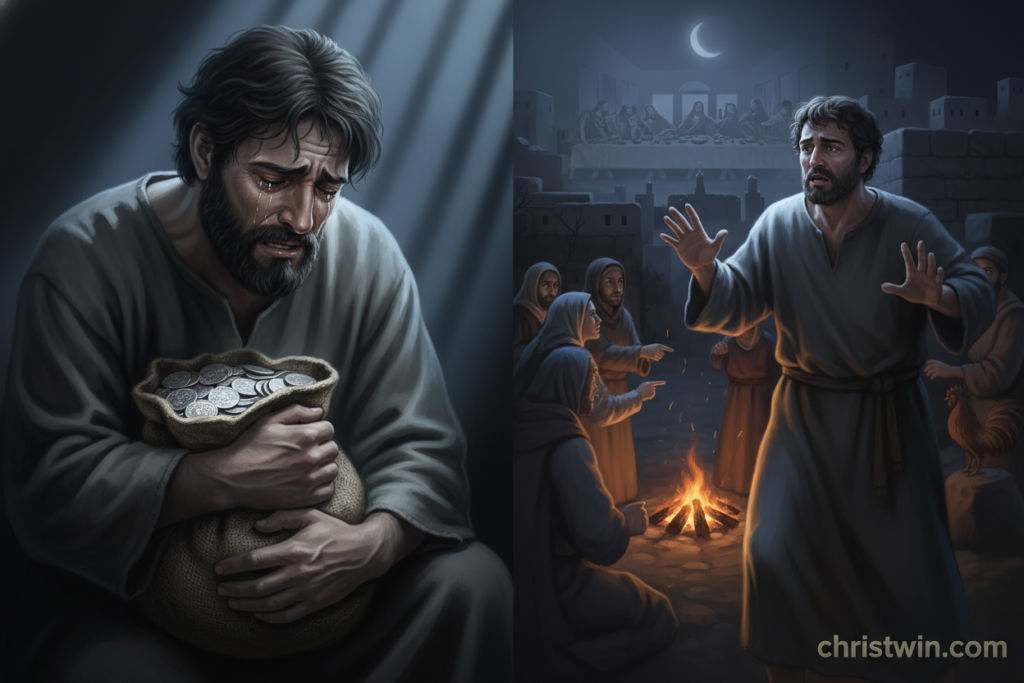
Judas Iscariot’s betrayal is famous in the New Testament. Peter’s denial was different, though. Judas betrayed Jesus to his enemies. Peter denied knowing him.
Here are some key differences:
- Intent: Judas betrayed Jesus on purpose. Peter denied him out of fear.
- Consequences: Betrayal led to Jesus’ arrest. Denial didn’t cause his crucifixion.
- Response to Guilt: Judas felt so guilty he killed himself. Peter felt remorse and sought forgiveness.
Different Responses to Guilt
Judas and Peter showed us two paths guilt can take. Judas was consumed by guilt and took his own life. Peter, filled with remorse, sought forgiveness from Jesus.
Key points about their responses include:
- Direction of Emotions: Judas turned inward, leading to despair. Peter turned outward, seeking forgiveness.
- Action Taken: Judas’ action was irreversible. Peter’s action led to restoration.
- Spiritual Outcome: Judas’ story ended in loss. Peter’s story had redemption and a key role in the early church.
Why Peter Found Restoration
Peter’s restoration after his denial shows Jesus’ grace and forgiveness. Several factors helped Peter:
- Jesus’ Prayer for Peter: Jesus prayed for Peter’s faith before his denial.
- Peter’s Genuine Repentance: Peter’s remorse was real, and he sought Jesus after his resurrection.
- Forgiveness and Reconciliation: Jesus forgave Peter and gave him a new role among the disciples.
This comparison teaches us that failure is not the end. The path we choose after failure determines our outcome. Peter’s story gives us hope and a model for redemption.
Judas’s Remorse and Repentance
After handing Jesus over, Judas felt very bad. This led to many debates among theologians for centuries. The story in Matthew 27:3-5 shows what Judas thought and did after betraying Jesus.
Evidence of Genuine Regret
Judas felt bad and gave back the thirty pieces of silver. He knew he had done wrong by betraying innocent blood. This shows he was truly sorry for his actions.
The word “metamelētheis” in the Bible means he changed his mind. But, how deep his regret was and if he really repented is debated.
Key aspects of Judas’s remorse include:
- Returning the thirty pieces of silver
- Acknowledging his sin
- Demonstrating regret for his actions
Was His Repentance Complete?
Many question if Judas fully repented. He felt bad and gave back the silver, but then he hanged himself. This makes people wonder if he really changed his ways.
True repentance means not just feeling bad but also turning away from sin. It’s not clear if Judas did this fully.
The Timing of His Suicide
Judas hanged himself before Jesus was crucified, as Matthew 27:5 says. This timing makes people think about Judas’s remorse and what happened next.
Some think Judas killed himself out of hopelessness, not true repentance. This shows how important it is to know the difference between feeling bad and really changing.
Theological implications of Judas’s actions include:
- The danger of despair as a spiritual state
- The importance of genuine repentance
- The consequences of sin without redemption
God’s Sovereignty and Judas’s Free Will
When we look at Judas’s betrayal, we face a big question. How do God’s power and Judas’s choices mix? This question helps us understand God’s plan and our choices in the Bible.
Was Judas Predestined to Betray Jesus?
The Bible says God’s power is not stopped by us, but it also talks about our choices. Judas’s story makes us wonder about fate. Was he chosen by God, or did he choose to betray Jesus? The Bible says Jesus knew Judas would betray Him, but Judas made his choice.
For example, John’s Gospel says Jesus picked Judas, knowing he would betray Him (examples of prophecies in the Bible). This shows how God’s power and our choices work together.
Responsibility Despite Divine Foreknowledge
Even with God knowing what would happen, we are not free from blame. Jesus held Judas accountable, even though He knew what Judas would do. This is shown when Jesus told Judas to do what he was going to do quickly (John 13:27).
The main points are:
- God’s knowing what will happen doesn’t mean we can’t choose.
- We make choices within God’s plan.
- We are responsible, even if God knew what we would do.
The Role of Prophecy in Judas’s Actions
Prophecy was key in Jesus’s death, including Judas’s betrayal. Old Testament prophecies said about the betrayal and what would happen to the money (Zechariah 11:12-13). These prophecies show God’s plan using our actions.
Key Prophecies Related to Judas:
- Betrayal for thirty pieces of silver (Zechariah 11:12-13).
- The purchase of the potter’s field with the betrayal money (Zechariah 11:13; Matthew 27:9-10).
In conclusion, Judas’s story shows how God’s power and our choices work together. God’s plan includes our actions, as seen in Judas’s betrayal.
Conclusion
You’ve learned about Judas Iscariot’s story. This includes his role as a disciple, his betrayal, and different views on his fate. Think about how his story affects your faith and understanding of the Bible.
Judas’s story warns us about greed and despair. It shows the need for true repentance. His fate is debated, but his story teaches us about God’s power, our choices, and forgiveness.
Reflect on Judas’s story to grow your faith. Use what you learn to connect deeper with your beliefs and practices.
