
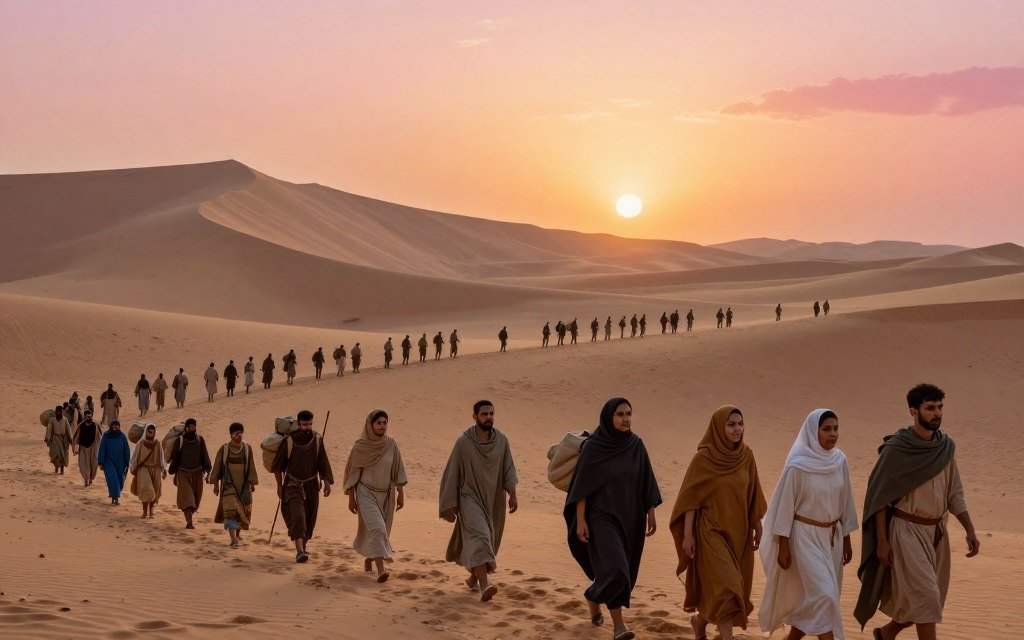
Have you ever thought about how many people left Egypt for the Promised Land? The Bible tells us about two counts of people in the book of Numbers. But, scholars disagree on these numbers.
Why is knowing the exact number important? It helps us understand the biblical story better. We’ll look into the Bible and different views on the Israelites exodus numbers. This will give us a deeper look into this key moment in biblical history.
The Biblical Narrative of the Exodus
Exploring the Exodus, you’ll learn about the Israelites’ big escape from Egypt. The book of Exodus tells how they were slaves for 430 years. It says Israel grew fast while in Egypt (Exodus 1:7).

Moses and the Call to Lead the Israelites
Moses is key in the Exodus story. He was born to Hebrew parents but raised by an Egyptian princess. He was called by God in a burning bush (Exodus 3:2-4:17).
Moses was hesitant at first but accepted the challenge. God promised to be with him.
Moses had to ask Pharaoh to let the Israelites go. He did this with God’s power behind him. This showdown between Moses and Pharaoh is a big part of the Exodus story.
The Ten Plagues and Pharaoh’s Release
God sent ten plagues on Egypt to make Pharaoh let the Israelites go. These plagues showed God’s power over Egypt’s gods (Exodus 7:14-12:30). The last plague spared the Israelites but ki+lled Egypt’s firstborn sons.
The plagues ended with the Israelites being free. But Pharaoh soon wanted them back. This led to a big fight at the Red Sea.
Crossing the Red Sea
The Red Sea crossing is a miracle in the Exodus story. The Israelites were trapped by Pharaoh’s army. But God parted the waters, letting them cross safely (Exodus 14:21-31).
When the Egyptians tried to follow, the waters closed, kil+ling them. This event ended the Israelites’ time in Egypt and started their journey to the Promised Land.
How Many Israelites Left Egypt To The Promise Land? Biblical Numbers
The story of the Israelites leaving Egypt is very interesting. Many people wonder how many left. The Bible tells us about their journey and how many were there.

The Book of Numbers is key to knowing the numbers of Israelites who left Egypt. The Census in the Book of Numbers helps us figure out these numbers.
The Census in the Book of Numbers
The Book of Numbers talks about two big counts of Israelites. The first count was in Numbers 1 when they were at Sinai. It counted men who could fight, showing how many left Egypt.
The 600,000 Men of Military Age
Numbers 1:46 says there were 603,550 men who could fight. The Levites were counted separately (Numbers 3:39). So, 600,000 men is often mentioned when talking about leaving Egypt.
Total Population Estimates Based on Biblical Texts
To guess the total number of Israelites, scholars multiply the number of fighting men. They add women, children, and the elderly. This makes the total number around 2 to 3 million. This guess comes from the Bible and helps us understand the Exodus better.
Knowing these numbers shows how big the Exodus was. It also shows the challenges the Israelites faced on their way to the Promised Land. The Bible gives us a deep look into this important event in history.
Interpreting Biblical Numbers: Literal vs. Symbolic
Understanding the numbers in the story of the Israelites’ exodus is tricky. It involves knowing ancient Hebrew numbers. You must think about the time period, language, and cultural meaning of these numbers.
Ancient Hebrew Numerical Systems
The word ‘elep‘ is often translated as “thousand” (Exodus 18:21). But some think it might mean “clan” or “military unit.” This different view changes how we see the Israelites’ numbers during their journey.
The word ‘elep‘ can mean different things. It’s not just about counting. It’s about understanding the Israelites’ organization and social life during their travels.
Symbolic Significance of Numbers in Hebrew Tradition
Numbers in the Bible often have special meanings in Hebrew tradition. For example, the number 40 is linked to testing or preparation, like the 40 years in the wilderness. Knowing these meanings helps us understand the Israelites’ journey better.
Numbers in the Bible are not just for counting. They tell us spiritual and theological stories. By looking at these numbers, we can learn more about the biblical story.
Translation Challenges Across Ancient Texts
Translating ancient texts, like the Hebrew Bible, is hard. The original language’s details can get lost, and the cultural background might not be clear today. This is true for numbers, where the original meaning can be hard to find.
Scholars must think deeply about the historical and cultural setting. This helps them understand the numbers in the biblical story. By doing this, we can grasp the significance of the Israelites’ exodus better.
Archaeological Evidence and Historical Context
Learning about the Exodus means looking at old digs and history. You’ll see different views on the Bible and how it matches with other evidence.
Egyptian Records and the Absence of Mass Exodus Evidence
Looking into the Exodus is interesting because there’s no clear proof in Egyptian records. James Hoffmeier, an archaeologist, says this doesn’t prove or disprove the Bible. It just shows how hard it was to keep records back then.
Egypt’s old records talk about pharaohs and big events that made Egypt look good. Not finding a record of the Exodus doesn’t mean it didn’t happen. It might just mean it wasn’t important enough to write down.
Population Estimates of Ancient Egypt
Guessing how many people lived in ancient Egypt is hard. Experts use clues like city sizes and farm work to make guesses.
Knowing how many people lived helps us understand the Exodus better. If Egypt was very crowded, moving a big group of people might have been easier.
Logistical Considerations for Page> Large Migrations Page>
Getting a big group like the Israelites to move would need a lot of planning. They’d need food, water, and ways to cross different lands.
The Bible says miracles helped the Israelites on their journey. Looking at how old societies moved people can help us see if this was possible.
As you keep learning about the Exodus, you’ll see how hard it is to check if the Bible is true with other evidence.
Scholarly Debates on Exodus Population Figures
Figuring out how many Israelites went on the Exodus is tricky. Scholars have different views on this. They look at the Bible and historical and archaeological findings.
Conservative Biblical Interpretations
Some scholars believe the Bible’s numbers are true. They think there were 600,000 men of fighting age. This means the whole family could have been 2-3 million people. This view comes from reading the Bible as it is written and trusting its history.
Minimalist Academic Perspectives
Other scholars doubt the Bible’s numbers. They think there were only tens of thousands of Israelites. They use history and archaeology to see the Bible in a new light.
Middle-Ground Approaches to the Numbers
Many scholars try to find a middle way. They look at the Bible, history, and archaeology together. They want to understand the Exodus numbers in the context of ancient times.
Recent Archaeological Discoveries
New finds have changed how we see the Exodus. They give clues about ancient Egypt and the Sinai. These discoveries help us understand the Exodus better.
The Tribal Divisions of Israel
It’s important to know about the tribal divisions of Israel. This helps us understand their journey from Egypt to Canaan. The Bible tells us how the Israelites were organized in the wilderness.
The Twelve Tribes and Their Sizes
The Israelites were split into twelve tribes. Each tribe came from one of Jacob’s twelve sons. The tribes were Reuben, Simeon, Levi, Judah, Dan, Naphtali, Gad, Asher, Issachar, Zebulun, Joseph, and Benjamin.
The sizes of these tribes were different. Some were bigger than others.
The book of Numbers gives us info on the sizes of the tribes. For example, Judah was one of the biggest. Manasseh and Ephraim, from Joseph, also had big populations.
Tribal Organization During the Exodus
During the Exodus, the Israelites were organized in a special way. They camped around the Tabernacle, forming a square. This was for defense and to show their spiritual focus, with Levi near the Tabernacle.
The leaders in each tribe were key. They helped keep order and talked to Moses.
Leadership Structure Under Moses
Moses was the leader of the Israelites. He had a team of elders and leaders of thousands, hundreds, fifties, and tens. This helped manage the large group and make decisions.
The Levitical priests were also important. They took care of the religious rituals and kept the community’s spirit healthy.
The Journey Through the Wilderness
How did the Israelites make it through the wilderness? The Bible tells a story of faith and help from above. You’ll learn about their struggles and the miracles that helped them.
Logistics of Moving a Large Population
It was hard to move over 2 million people through the desert. They needed food, water, and safety. The Bible shows how they were led and organized.
They were divided into tribes with leaders. This helped manage the huge group. It was a smart way to meet everyone’s needs on the move.
Food, Water, and Survival Challenges
Finding food and water in the desert was a big problem. The desert is tough and has little to offer. The Bible talks about how God provided manna and water, which were key to their survival.
Manna was like bread that came every day, except on the Sabbath. It was a test of their faith. Water was also a miracle, like when Moses hit the rock at Meribah.
The Miracle of Manna and Water
The stories of manna and water are famous. These miracles were more than just food and water. They were about God’s promise to His people.
Manna taught the Israelites to trust God every day. It was a time of spiritual growth, teaching them to obey and trust God.
The Tabernacle and Religious Organization
The tabernacle was key to their religious life in the wilderness. It was a place of worship and a sign of God’s presence. God told Moses how to build it, showing His care for His people.
The tabernacle had the Ark of the Covenant, God’s throne. Priests, led by Aaron, took care of it. They did sacrifices and rituals to keep the covenant alive.
Thinking about the Israelites’ journey reminds us of the power of faith, organization, and God’s help. Their story teaches us about trust, obedience, and God’s presence in tough times.
The Forty Years of Wandering
For forty years, the Israelites wandered in the wilderness. This time was filled with challenges and growth. You will learn about their struggles and spiritual growth.
The Census at Sinai vs. the Census in Moab
The Bible tells us about two censuses of the Israelites. One was at Sinai (Numbers 1) and the other in Moab (Numbers 26). These censuses show us the changes in their numbers during their journey.
At Sinai, they counted the Israelites before they started their journey. In Moab, they counted them right before entering the Promised Land. By comparing these, we see how their numbers changed and God’s faithfulness.
Population Changes During the Wilderness Period
The Israelites’ numbers changed a lot during their forty years. The number of men of military age stayed about the same, around 600,000. But, the numbers among the tribes changed.
Key observations include:
- Some tribes grew, while others shrank.
- The Levites, not counted with the military, grew a lot.
- The total population, including women and children, was much bigger.
The New Generation Entering Canaan
A new generation of Israelites was ready to enter Canaan. The wilderness was a time of testing and growth for them.
This new generation was ready for a fresh start. They had learned from their past and were committed to God.
Thinking about the Israelites’ journey reminds us of the value of faith and obedience. Their story shows God’s presence and guidance in their lives.
The Conquest of Canaan and Settlement Patterns
As you explore the biblical account of the Israelites’ journey to Canaan, you’ll discover the intricacies of their conquest and settlement. The Israelites’ expedition into Canaan was a key moment in their history. It marked the fulfillment of a divine promise.
This period is filled with military campaigns, the allocation of land, and the establishment of a new societal order.
Military Capabilities Based on Population Size
The military capabilities of the Israelites upon entering Canaan were influenced by their population size. The biblical account mentions 600,000 men of military age. This suggests a large force.
But, the actual number of warriors and their effectiveness varied. This was due to training, leadership, and divine intervention as described in the biblical narrative.
Archaeological Evidence of Israelite Settlement
Archaeological findings offer insights into the Israelites’ settlement patterns in Canaan. Excavations have uncovered new settlements and cultural shifts. These discoveries help to corroborate the biblical account and offer a more nuanced understanding of the Israelites’ presence in Canaan.
Reconciling Biblical Accounts with Archaeological Findings
Reconciling the biblical narrative with archaeological evidence is complex. The Bible gives a detailed historical and theological account. Archaeological findings provide tangible evidence of past cultures.
Scholars continue to study and compare these sources to gain a more complete understanding of the Israelites’ conquest and settlement of Canaan.
Distribution of Tribes in the Promised Land
The distribution of the Israelite tribes in Canaan involved military conquest and land allocation. The biblical account describes how the tribes were allocated specific territories. This shaped the social, political, and religious landscape of the Israelites in their new homeland.
Understanding this distribution is key to grasping the subsequent history and identity of the Israelites.
Conclusion: Understanding the Exodus Numbers in Context
You’ve learned about the Israelites’ journey out of Egypt. This story is full of numbers and meanings. The question of how many Israelites made it to the promised land is complex.
The Bible tells us about the Israelites’ journey. It’s filled with numbers that are important to the story. Knowing these numbers helps us understand the journey better.
Thinking about the different views and history makes the story more meaningful. The Israelites’ journey teaches us about faith and perseverance. It shows us God’s promises come true.
Looking into the numbers and events of the exodus helps us see the Bible’s story in a new light. It shows us how the story is relevant today.
